Learning powered by

classroom games


Engageli is the only virtual classroom solution in the market that incorporates game-based learning strategies.

Game-based learning introduces challenge, competition, and goals that naturally capture attention and keep learners focused. 

Games rely on practice and recall, which reinforces learning and helps with concept retention. Instructors can use Engageli classroom analytics,

including game engagement and responses, to identify where learners need additional support and adjust instruction accordingly.


Subheading (4)


Games designed to reinforce active learning

Tables (14)

Sprints


Turn quizzes into interactive games with music, timers, and live leaderboards that energize the classroom. Sprints in Engageli classrooms encourage active learning while providing instructors instant formative assessment to gauge gaps in learner understanding. Leaderboards encourage friendly competition, awarding points for both speed and accuracy to increase focus, motivation, and engagement.

In Playback Rooms, Sprints bring that same competitiveness and time pressure to asynchronous learning. Learners can see how they compare to others through leaderboards, adding a sense of challenge and momentum that keeps them motivated even outside of live sessions.

Trivia Blast


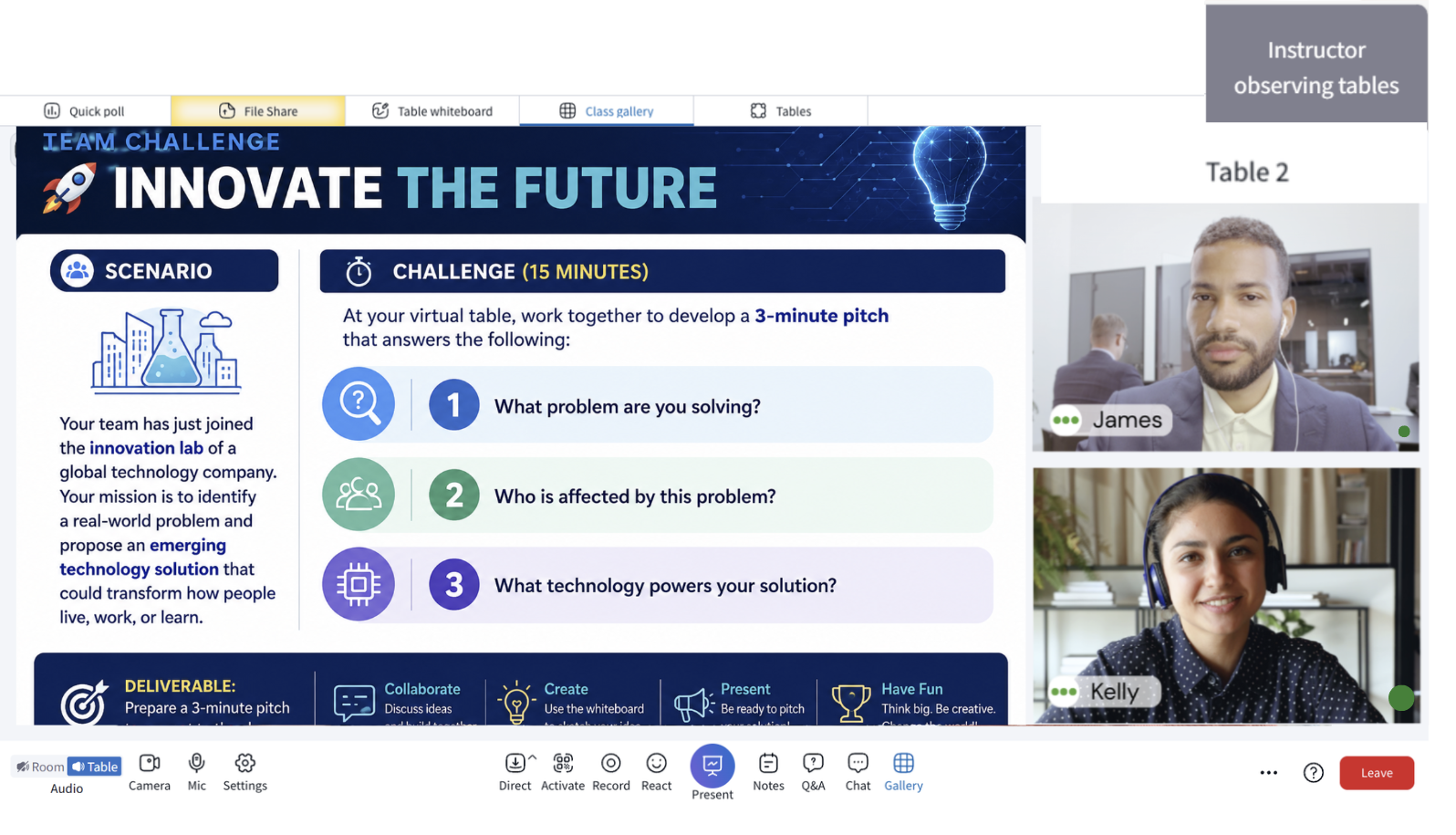
Create a fast-paced trivia game where learners compete in their virtual table groups to answer questions within a set time limit. Use Engageli’s timer feature to add excitement and encourage quick thinking. Learners can use the virtual whiteboard to write down their answers collaboratively and share them with the class. 

Name each table with team names to spark teamwork and friendly competition.


Tables (9)


Quiz Game (2)


Quiz Show


Host a quiz show challenge where tables collaborate and compete to answer questions. Use Engageli's podium to run the game, with raised hands determining the order of responses. 


This game turns learning into a high-energy experience that motivates quick thinking and supports knowledge mastery.

Streaks


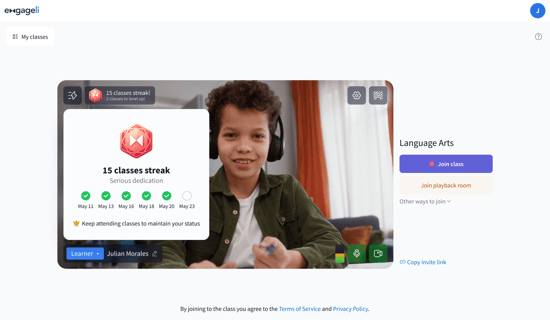
Coming soon! Encourage learners to show up consistently, turning participation into a habit rather than a one-time effort using attendance streaks. Streaks reinforce regular presence, helping learners stay on track and reducing drop-off over time. Consistent attendance builds classroom continuity, helping learners stay engaged, retain knowledge, and ultimately achieve stronger outcomes.

Learners love streaks because they turn everyday tasks into a fun challenge with clear goals and instant rewards. The sense of progress and “don’t break the chain” motivation makes them feel accomplished and eager to keep going.


Lobby – 5


Ready to see Engageli in action?

Speak to our team of educators to see how Engageli's virtual classroom encourages participation through game-based learning while giving instructors visibility into engagement.

bg1

Got questions? We’ve got answers

Game-based learning is teaching and learning through structured games and game-like activities, where the game itself is the learning experience, not just a reward wrapped around one. Trivia competitions, Jeopardy-style quizzes, role-play scenarios, collaborative whiteboard challenges, and leaderboard-driven retrieval practice are all forms of game-based learning.

It's different from gamification, which adds game elements (points, badges, leaderboards) to otherwise non-game activities. Game-based learning makes the game the activity.

Engageli supports game-based learning through built-in tools: the Learning Arcade generates leaderboard quizzes from your course content, tables compete in trivia and Jeopardy-style games, the podium moderates buzzer-style competitions, and the whiteboard hosts collaborative challenges from quiz shows to mathematical code-breakers.
The distinction is about where the game sits. In game-based learning, the game IS the lesson, students learn through playing. In gamification, game elements are added to existing activities to make them more engaging: points for completing homework, badges for finishing modules, leaderboards for class participation.

Both have their place. Game-based learning works well when the subject matter benefits from active retrieval, competition, or role-play. Gamification works well when you want to motivate consistent behavior over time without redesigning the core activity.

Engageli supports both. The Learning Arcade and table-based competitions are pure game-based learning. Leaderboard points, digital badges, and streak tracking are gamification layers you can add to regular instruction. Most successful programs use some of each, depending on the lesson.
Digital game-based learning is game-based learning delivered through digital tools like  software, platforms, or online environments,  rather than physical materials or in-person game mechanics. It's what game-based learning looks like in virtual and hybrid classrooms.

Digital game-based learning covers a wide range: standalone educational game apps, classroom platforms with built-in game features, AI-generated quiz games, and simulation environments. What separates effective digital GBL from entertainment software is integration with actual learning objectives and meaningful feedback data.

In Engageli, digital game-based learning is built into the classroom itself. The Learning Arcade auto-generates leaderboard quizzes from instructor content with streaks and multipliers. Tables compete in Jeopardy, trivia, and collaborative puzzles. The podium moderates buzzer-style competitions. And because it all runs inside Engageli, game participation flows directly into the same engagement analytics as everything else, who played, what they got right, and what they need to review.
In practice, game-based learning in Engageli looks like activities you'd recognize from in-person classrooms, adapted for a virtual environment where every student can participate simultaneously.

Table-based team games. Each Engageli table becomes a team. Trivia Blast runs fast-paced questions with the timer; Group Jeopardy lets tables pick categories and point values; collaborative whiteboard challenges let teams brainstorm visually together.

Podium-moderated competitions. The podium acts like a classroom buzzer - students raise their hands and the queue orders them. The instructor calls on whoever raised first. Perfect for trivia, debate, and Socratic-style questioning.

Leaderboard-based quizzing. Learning Arcade generates quiz games from course content that students play on their own schedule. Streaks, multiplier bonuses, and leaderboard spots turn review into competition. Afterward, the instructor sees exactly what concepts each learner missed.

At scale, this works. Dr. Ruth Stow at Coventry University runs a 700-student interprofessional module on Engageli, using built-in polls, tables, and games to maintain engagement across disciplines and cohorts.
Game-based learning draws from three well-established strands of cognitive and motivational research.

Intrinsic motivation. Self-determination theory shows that activities with autonomy, competence feedback, and social connection produce sustained engagement far better than extrinsic rewards. Games naturally deliver all three.

Retrieval practice. One of the most-studied findings in cognitive science: actively recalling information strengthens memory more than re-reading or passive review. Quiz-style games are structured retrieval practice.

Safe failure. Games create low-stakes environments where wrong answers don't carry real consequences. That reduces anxiety around risk-taking, which is the prerequisite for deeper engagement with difficult material.

These effects also align with Engageli's broader active learning research: learners in active sessions score 54% higher than learners receiving the same content passively. Game-based learning is one of the mechanisms that keeps learning active in environments, like virtual classrooms, where passivity is the default.
Five benefits that consistently show up in the research:

1. Intrinsic motivation. Learners engage because they want to play, not because they have to complete an assignment. That shift in motivation compounds over time.

2. Safe failure. Wrong answers in a game don't carry real consequences, which encourages learners to take risks, guess, and try ideas: the behaviors that lead to deeper learning.

3. Retrieval practice. Quiz-style games are structured retrieval, one of the most reliably effective learning techniques in cognitive science. Learning Arcade is built entirely around this principle.

4. Social engagement. Leaderboards, team play, and cohort competition activate peer dynamics that lectures and solo study can't. Especially valuable in virtual classrooms, where cohort connection is usually weak.

5. Measurable data. Every game played in Engageli generates engagement data , who participated, what they got right, where they struggled, feeding into the same analytics dashboard as polls, Q&A, and attendance.
Four concrete outcomes show up consistently when game-based learning is well-designed:

1. Higher engagement. Especially for students who don't respond to traditional lecture formats:  the ones who sit quietly through a Zoom call but light up in a competition. Games change the distribution of who participates.

2. Stronger retention. Retrieval practice through quiz games is one of the best-studied mechanisms for long-term memory. Students who review material through game-based quizzing retain more than students who review through re-reading.

3. Lower anxiety around wrong answers. In a game, wrong answers are part of play. That framing makes students more willing to attempt hard questions, guess at uncertain answers, and work through confusion rather than hide it.

4. Better cohort connection. In online classrooms especially, shared game experiences build the peer bonds that static content can't. Students who compete together, win together, and lose together form a cohort, not just an email list.
Yes, when it's designed well. The research on game-based learning is consistent: it improves engagement, retention, and motivation when games are aligned to specific learning objectives rather than bolted on for fun.

Four variables determine whether GBL actually works:

1. Clear educational goals behind each game. A game without a learning objective is entertainment, not instruction. Every activity should tie back to something specific the learner should know or do after.

2. Balance between challenge and accessibility. Too easy and learners disengage. Too hard and they quit. The best games adapt to the learner's current level.

3. Immediate feedback. Games work because learners find out right away whether they were right. Feedback that comes a week later, or never, loses the learning benefit.

4. Integration with the broader class flow. One-off games don't stick. Games work best when they're part of a recurring rhythm in the course.
Learning Arcade is Engageli's AI-powered game generator for classrooms. Upload your notes, paste in slides, or just describe a topic and Learning Arcade builds a leaderboard-based quiz game that students play on their own schedule.

The game mechanics are built for engagement: streaks reward consecutive correct answers, multiplier bonuses reward speed and accuracy, and the leaderboard creates cohort-wide competition. No student accounts, no downloads, students join with a link, play, and compete.

After the game ends, the instructor sees exactly which concepts each learner missed, which questions tripped up the whole cohort, and what to reteach. The result: retrieval practice as a competitive game, plus the analytics to act on what the game reveals.

Learning Arcade sits alongside Engageli's other game-based learning tools, table-based team competitions, podium-moderated buzzer games, and whiteboard challenges, as part of a full toolset for turning content review into active play.
bg2