

An attendance report can confirm that a student logged in, but it has nothing to say about whether that same student understood the lesson, took part in it, or was even at the keyboard when it mattered. That gap between what the report shows and what actually happened is usually where disengagement hides, long before it turns into an absence a district has to explain.
For K-12 districts, the central question isn't whether to choose synchronous or asynchronous learning. It is whether the platform running either model can prove a student was actually learning. Because engagement, attendance, and outcomes are the core metrics state funding depends on, the strongest virtual programs must deliver both live structure and independent flexibility, backed by verifiable engagement data.
What Are District Leaders Actually Trying to Solve With Online Learning?
Every district leader evaluating a virtual or hybrid program is weighing five connected priorities: engagement, flexibility, attendance, accountability, and measurable outcomes. Three of those (engagement, attendance, and outcomes) are directly tied to state funding formulas.
- Disengagement rarely announces itself. A student who stops participating usually shows subtle signs well before an absence occurs: shorter sessions, fewer contributions, or a camera that stays off. By the time attendance officially drops, a district's intervention options have narrowed significantly and the window of opportunity to re-engage the student may be lost.
- Flexibility is essential for retention. Districts serve students managing medical conditions, mental health needs, or unique personal circumstances. If a district cannot offer a high-quality flexible option, families will find one that can, taking their enrollment and state funding with them.
- Accountability closes the loop. Districts must demonstrate to state boards and local communities that instructional time is meaningful. A log-in is not evidence of learning; it is merely evidence of a log-in.
What Is Synchronous Learning, and Where Does It Help or Hurt?
Synchronous learning is real-time instruction: a teacher and students interacting in a virtual classroom together, at the same time.
Benefits
- Immediate assessment of understanding: Teachers can gauge in real time whether a concept has landed.
- Classroom community: Live interaction helps students build meaningful relationships with peers and instructors.
- Discussion and collaboration: Real-time give-and-take creates energetic peer learning that is difficult to replicate asynchronously.
Challenges
- Scheduling constraints: Requires all students to be available simultaneously, limiting flexibility.
- Passive "camera-off" presence: Traditional video conferencing tools make it easy for students to log in and tune out without the teacher knowing.
What Is Asynchronous Learning, and Where Does It Help or Hurt?
Asynchronous learning lets students work through instructional material at their own pace, outside of a shared schedule.
Benefits
- High flexibility: Accommodates students who cannot attend fixed live sessions due to personal or medical needs.
- Personalized pacing: Students can take extra time on challenging concepts without holding back the rest of the class.
- Easy review: Materials can be revisited as many times as necessary to master the subject.
Challenges
- Completion risks: Without the routine of a live session, self-direction can stall and lead to total disengagement.
- Student isolation: Can feel lonely without deliberate design structures for peer connection.
- Feedback delays: Real-time guidance and instructor interventions are missing from a purely self-paced format.
Synchronous vs. Asynchronous Learning at a Glance
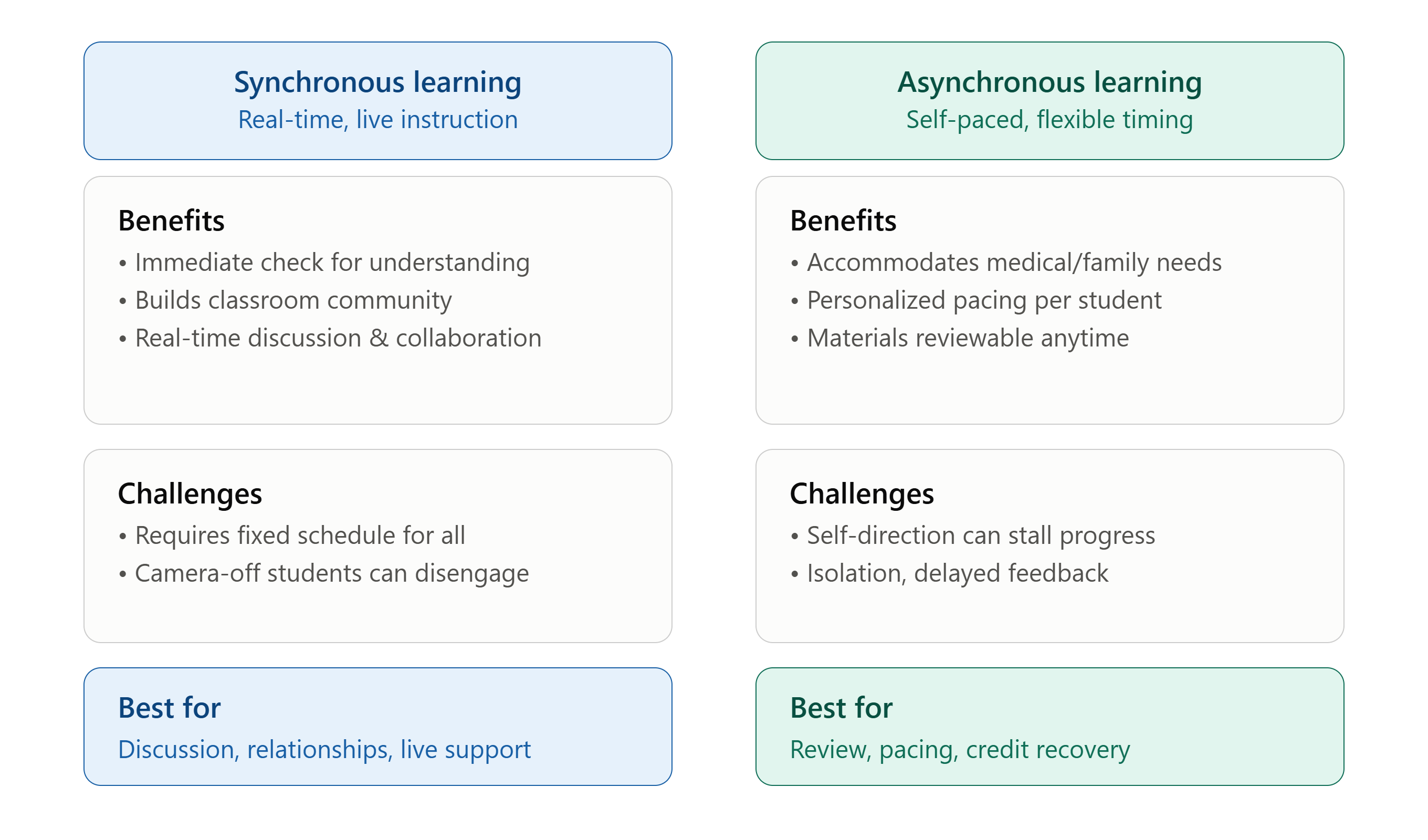
| Dimension | Synchronous Learning | Asynchronous Learning |
|---|---|---|
| Timing | Real time; everyone participates together | Self-paced; students choose when |
| Teacher visibility | Immediate; teacher sees understanding as it happens | Delayed; visibility depends on the platform's data |
| Flexibility | Low; requires a fixed schedule | High; accommodates medical, family, or scheduling needs |
| Community | Strong by default | Requires deliberate design |
| Accountability | Attendance is visible, engagement is not guaranteed | Completion is trackable, but easy to fake with a login |
| Best for | Discussion, relationship-building, live intervention, group-based learning | Review, pacing, credit recovery, flexible access, independent study |
Why Isn't Posting Materials to an LMS the Same as Running an Online Program?
Many districts offer both live sessions and self-paced modules. While that is progress, posting a recorded video and a worksheet to a Learning Management System (LMS) is content storage, not a virtual program.
The challenge for K-12 leaders is not access to content; content is abundant. The challenge is delivering active learning, maintaining accountability for comprehension, and driving measurable outcomes.
Students need flexibility, but not at the expense of active teacher interaction. A program that trades connection for convenience hasn't solved a district's problem; it has simply displaced it.
What Data Do Districts Actually Need to Prove an Online Program Is Working?
Basic attendance logs do not satisfy funding audits, school boards, or parents deciding whether to stay in a district. To evaluate success, district leaders need clear reporting on:
- Duration and Depth: Who attended and stayed engaged, rather than who simply opened a browser tab.
- Active Participation: Who actively participated in polls, discussions, and embedded activities.
- Concept Mastery: Where specific learning gaps occurred during a lesson.
- Early Warning Signals: Which students are slipping behind before disengagement turns into an unexcused absence.
- Instructional Impact: Whether specific strategies are driving performance gains over time.
Meeting tools designed for corporate video calls were never built to capture this level of pedagogical insight. Fulfilling these metrics requires learning platforms built specifically for K-12 engagement.
.png?width=1064&height=821&name=Post-Program%20Attendance%20Report%20(2).png)
Does the Right Mix Change by Grade Level?
Yes. Treating every grade level identically is one of the most common design flaws in virtual education.
- Younger Students (Grades K–5): Require high synchronous structure. Early learners generally lack the executive function needed to self-direct through independent modules without significant home support. Guided live exploration in small groups keeps young learners supported.
- Older Students (Grades 9–12): Can thrive with greater asynchronous flexibility, particularly for credit recovery or advanced coursework where self-pacing is an asset rather than a hurdle.
Why Synchronous Interaction Matters Beyond Academics
Live interaction directly impacts student motivation, peer connection, and mental health. Fully asynchronous environments risk isolating students, regardless of how well-designed the curriculum content may be.
As federal pandemic-era funding (such as ESSER) concludes, districts can no longer rely on temporary grants to bridge engagement gaps. Community-building strategies and active engagement features must be natively embedded into the virtual delivery platform itself.
The Shift to Engagement Reporting
State oversight is shifting rapidly toward verifiable instructional engagement. Across multiple states, regulatory bodies are signaling a move away from simple log-in metrics toward verifiable active engagement data during audits. (Note: Districts should verify specific active-time reporting requirements with their respective State Education Agency).
The overarching direction is clear: states are holding virtual programs accountable for active participation and genuine learning, not passive enrollment without proving learner outcomes.
If K-12 Districts Can't Deliver Blended Active Learning, What Happens?
As districts face increasing pressure to improve outcomes while doing more with limited resources, the challenge is ensuring every student actively participates and learns. The districts that succeed will be those that use multimodal classroom technology to create measurable engagement, foster collaboration, and provide educators with actionable insights that help every student stay on track.
Families who need flexibility, whether for medical reasons, scheduling, or simply a better fit, will find a program that offers it, and the enrollment and funding follow the student out the door. The losing district still must meet its own state reporting requirements, which means it also carries the burden of explaining that departure.
Enrollment tends to follow proof of engagement. When a family chooses a virtual competitor over their home district, it is usually because that program could demonstrate real student participation, while the home district could only point to a login. The platform is where districts can close that gap right now, well ahead of any policy change.