

This is the first post in our series, "The Hidden Risks of Virtual Classrooms," where we explore the common challenges K-12 schools face when using generic video conferencing tools for instruction.
Check out the other blogs in the series here:
Breakout rooms are a cornerstone of collaborative learning in the virtual classroom. They offer a space for students to engage in small-group discussions, work on projects, and learn from one another.
But what happens when these spaces become blind spots for educators? What if the collaboration turns into conflict, and the teacher has no way of knowing until it's too late?
.png?width=700&height=391&name=Untitled%20design%20(35).png)
The Scenario: A Biology Lesson Goes Wrong
Imagine a high-school biology class deep in a lesson on genetics. The teacher, wanting to encourage peer-to-peer discourse, divides the students into breakout rooms to work on a Punnett square exercise. The students seem engaged, and from the main gallery of the video conferencing platform, everything appears to be running smoothly. The teacher pops into a couple of breakout rooms, hears productive chatter, and feels confident that the students are on task.
However, in one of the breakout rooms, the conversation has veered off-topic. A few students start making jokes about a classmate's appearance, and the banter quickly escalates into targeted, hurtful comments in the room’s private chat. The targeted student falls silent, their camera turns off, but the harassment continues, invisible to the teacher who is managing the larger class.
The timer rings, the session ends, and the teacher is unaware that a serious incident has just occurred under their supervision.
 The Impact: A School's Reputation on the Line
The next morning, the principal receives an urgent call from an irate parent. Their child, the target of the harassment, took a screenshot of the chat and is now deeply distressed. The parent demands action and threatens escalation, citing the school's responsibility to provide a safe learning environment.
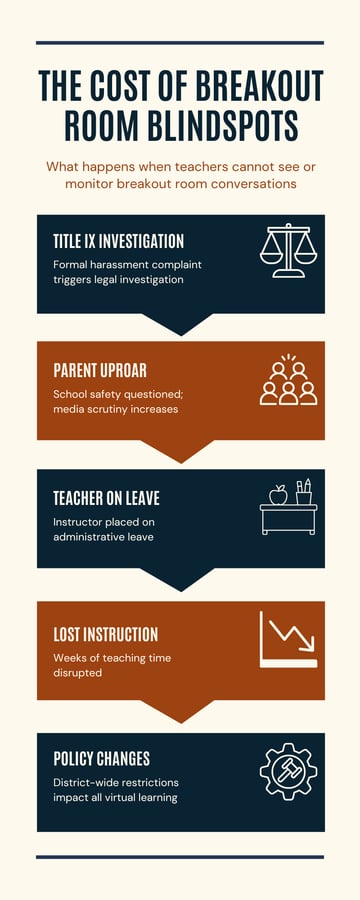
The situation quickly spirals. A formal Title IX harassment investigation is launched, a process that is both time-consuming and emotionally draining for everyone involved. The teacher, despite being unaware of the incident, is placed on administrative leave pending the investigation, leading to instructional disruption and a significant blow to morale.
News of the incident spreads through the school community, causing an uproar among parents who question the safety of the virtual learning program. The school's reputation is damaged, and trust between the administration, teachers, and families is severely eroded. In the aftermath, district leaders are forced to re-evaluate their policies on breakout rooms, weighing the promise of small-group engagement and improved outcomes against the safety, compliance, and reputational risks of limited oversight.
The fallout from this single, unseen incident will be felt for months, impacting everything from student well-being to teacher retention.
The Underlying Problem: A Lack of Visibility
This scenario is not a result of a teacher's negligence; it is a failure of the technology. Most generic video conferencing platforms were designed for corporate meetings, not K-12 classrooms. Their breakout rooms are black boxes, offering no way for a teacher to have visibility into all groups simultaneously. To monitor conversations, the teacher must manually jump from one room to another, a process that is both inefficient and ineffective. This lack of oversight creates a high likelihood for negative interactions to go unnoticed, leaving students vulnerable and the school exposed to significant compliance and reputational risks.
Even platforms layered on top of these conferencing tools often inherit the same architectural flaw. While they may offer some additional features, they cannot un-build the built-in problem of limited visibility. So, the well intentioned teacher is forced to leave good behavior to chance when making the choice to engage students; a gamble no school should have to take.
The Solution: Purpose-Built for Learning
A truly safe virtual classroom requires a platform built with the realities of K-12 education in mind. Engageli was designed to provide educators with the tools they need to facilitate effective learning while ensuring student safety. With Engageli, teachers have a comprehensive view of all breakout groups from a single screen, through our patented virtual tables. They can silently observe the interactions at each table without joining the room, monitor all chat conversations, and even see which students are actively participating without having to jump between rooms.
This level of oversight is not about surveillance; it's about supervision. It allows teachers to be present for their students, to offer support when needed, and to intervene proactively before a situation escalates - just as they would in a physical classroom. Features specifically designed for K-12 like “Peek at Tables” and “Instructor Receives All Table Chat Messages” create transparent, manageable learning spaces. Teachers can also view all student cameras from one location, no matter their table group.
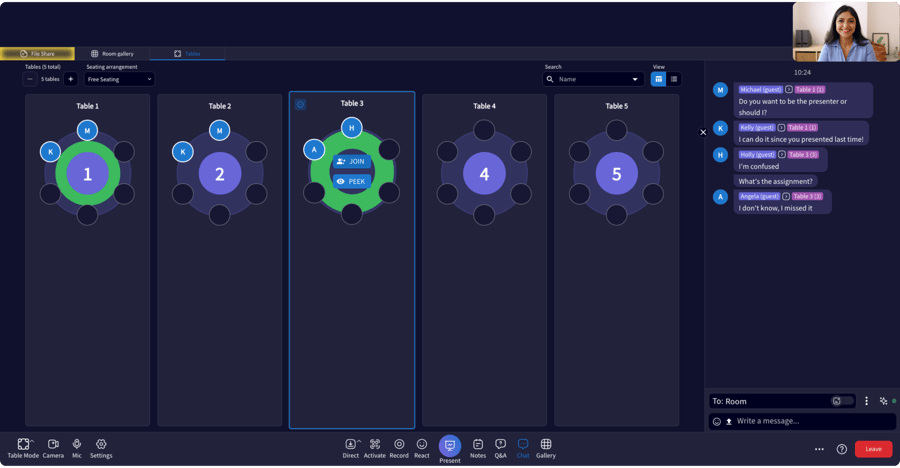
This built-in, automated supervision ensures that the classroom remains a safe and productive environment for all students, protecting them from harm and the district from unnecessary risk.
To learn more about how Engageli's platform can protect your students, visit our K-12 hub to see it in action and download helpful resources!