

This is the second post in our series, "The Hidden Risks of Virtual Classrooms," where we explore the common challenges K-12 schools face when using generic video conferencing tools for instruction.
Check out the other blogs in the series here:
Today’s world is highly connected. A single link can open a door to almost anywhere, including your classroom. Teachers and students share links constantly for lessons, assignments, and live sessions.
But when a link meant for a specific class is shared beyond its intended audience, the consequences can escalate quickly. What begins as convenience can turn a private learning space into a public one.
The Scenario: A Shared Link Admits an Unauthorized Guest
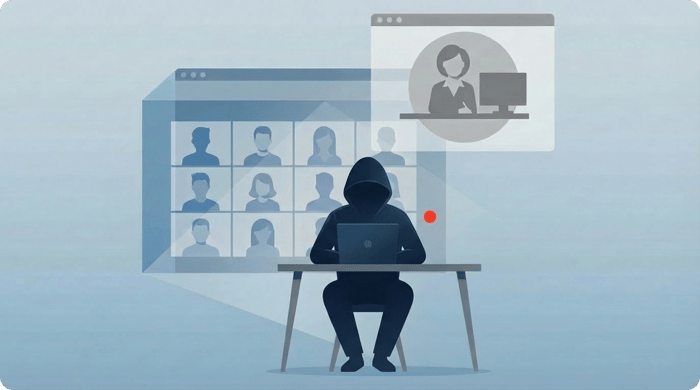
Imagine a 6th-grade social studies class in the middle of a discussion on digital citizenship. Students are engaged, participating, and collaborating online. During the session, a student casually forwards the class link to a friend at another school who is curious about what virtual class looks like. That friend posts the link in a group chat.
Moments later, a new participant appears. Their camera is off. The name is unfamiliar. Before the teacher can react or verify who has joined, the individual begins recording the session. Student faces, names, voices, and classroom interactions are captured. Just as quickly, the intruder leaves.
Hours later, short clips from the recording surface on social media, showing students’ faces and full names. What was meant to be a protected instructional space is now exposed to the public.
The Impact: Student Safety and Privacy Concerns
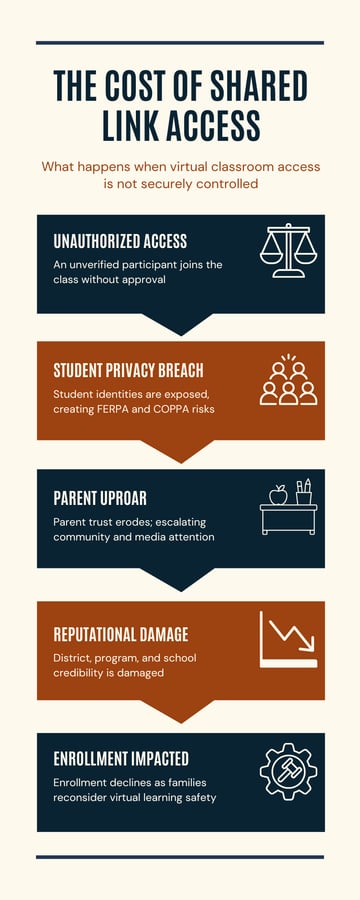
This sends shockwaves through the school community. Parents begin calling immediately, alarmed and angry. The school is now dealing with a potential data breach involving minors, raising serious concerns around FERPA and COPPA compliance. District legal counsel is pulled in, and an investigation begins.
Local media picks up the story. Headlines question how student privacy was compromised during a school-run class. Trust erodes quickly. Families who once felt confident in the school’s ability to protect their children now have doubts. Some withdraw their students entirely, concerned about safety and privacy.
A single unauthorized guest has triggered legal risk, reputational damage, and enrollment loss. The cost extends far beyond the class period where it occurred.
The Underlying Problem: The Illusion of Security
At the root of this incident is a system built on shareable links. Generic video conferencing tools rely on link-based access that was never designed for K–12 classrooms. Waiting rooms are often presented as a safeguard, but they are manual, inconsistent, and easy to bypass.
Teachers are forced to act as gatekeepers, juggling attendance, lesson delivery, and student management while trying to identify every name that appears on screen. All it takes is one distraction, a convincing display name, or a rushed moment for an intruder to slip through.
Link-based systems cannot distinguish between an enrolled student and a stranger. Once a link is shared, control is effectively lost. That creates unnecessary risk for schools and places an unfair security burden on teachers.
The Solution: Security Built Into the Classroom
Real classroom security does not rely on teachers policing access. It requires a system where access is granted by design.
Engageli classrooms use roster-based access tied directly to official school enrollment. Only authenticated students and approved staff can enter. Guest access and meeting links are disabled by default, and can only be enabled by administrators.
Because access is automated and enforced at the platform level, teachers can focus on instruction instead of monitoring entry points. Every participant in the room is there intentionally and verifiably.
.png?width=900&height=464&name=June%20Parent-Teacher%20Conferences%20(7).png)
In a secure classroom, the door is always locked. Only the right people have the key.
To learn more about how Engageli's platform can protect your students, visit our K-12 hub to see it in action and download helpful resources!