

By Anita Chawla, Chief Customer Officer, Engageli
When students go quiet in class, instructors often assume the problem is comprehension: the material was difficult, the explanation didn't land, or students weren't paying attention.
But sometimes the barrier to thinking out loud isn't understanding, it's the fear of being wrong in front of your peers.
That was one of the most striking ideas Dr. David Yeager, UT Austin researcher and author of 10 to 25: The Science of Motivating Young People, shared during a recent Engageli-hosted webinar. In his undergraduate course, he has redesigned class time around one goal: getting students to think, commit to an answer, discuss it, and revise their thinking rather than simply listen.
The results he reported are notable: approximately 95% attendance and 95% chat participation, without relying on extra credit or other participation incentives.
But the more interesting lesson may be why students participate.
What I Watched Happen in the Chat
During the webinar, Dr. Yeager demonstrated a technique he calls a “waterfall.”
He posed an open-ended question, sent participants into small groups to talk it through, and then asked everyone to type an answer in the chat but not send it. A timer counted down. Then everyone submitted at once. Twenty or twenty-five answers appeared almost simultaneously.
No one could wait to see what someone else wrote. No one could quietly change an answer after realizing theirs was different. And no single student had to take the risk of being the first person in the room to speak.
That small design choice reveals something important about participation. When we ask, “Why aren't students answering?”, we tend to focus on motivation or comprehension. But the structure of the interaction matters too.
Raising your hand first means taking a visible social risk. A simultaneous response changes that calculation. The students haven't suddenly become more confident. The environment has simply made participation safer.
To see the full recording of the webinar, visit: Driving Critical Thinking with Collaborative Learning.
Participation Is a Design Problem
This is the larger idea I took away from Dr. Yeager's approach.
Good teaching obviously requires clear explanation. But explanation alone doesn't tell us whether students are actively thinking. A student can follow a lecture closely without ever having to test an idea.
By contrast, asking a student to commit to an answer, explain their reasoning, encounter another perspective, and revise their thinking creates a very different kind of learning experience.
Dr. Yeager's goal is therefore not simply to maximize the amount of information students hear during class. It is to maximize the amount of authentic thinking they do. And that requires designing participation into the class rather than hoping it happens.
What the Routine Looks Like
The approach Dr. Yeager described is simply structured.
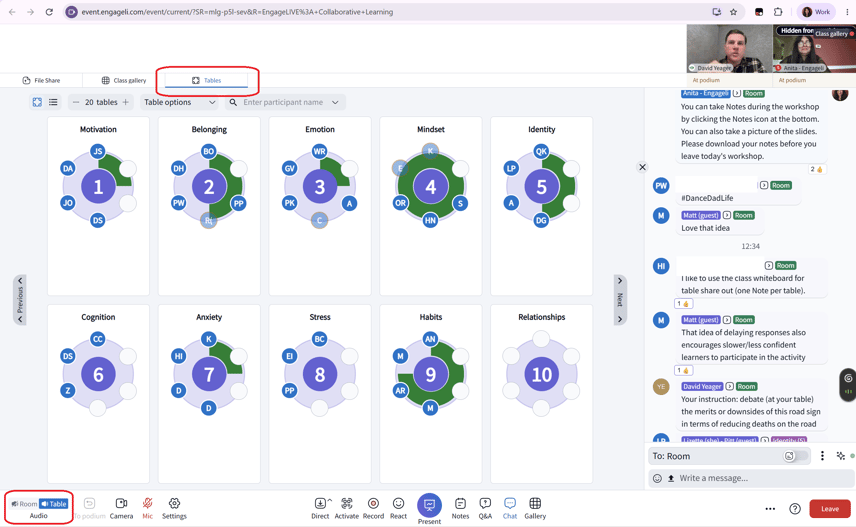
- Start with an open prompt, then move to group discussion. Students receive an open-ended prompt and discuss it in small, persistent groups (what Engageli calls Tables) before responding individually.
- Use a waterfall response. Everyone types an answer to the same prompt and submits simultaneously. Students have to demonstrate their own thinking before being influenced by the responses around them.
- Make correction part of the learning. Teaching assistants review several responses aloud, beginning with what is right before discussing what needs refinement. Being wrong isn't treated as a failure; it becomes another step in the learning process.
- Keep the rounds short. Dr. Yeager described roughly seven-minute discussion cycles, with several rounds during a class followed by a longer project activity. The structure keeps students moving between thinking, discussion, response, and feedback. Using the classroom timer keeps the rounds on pace and sets the timing expectation.
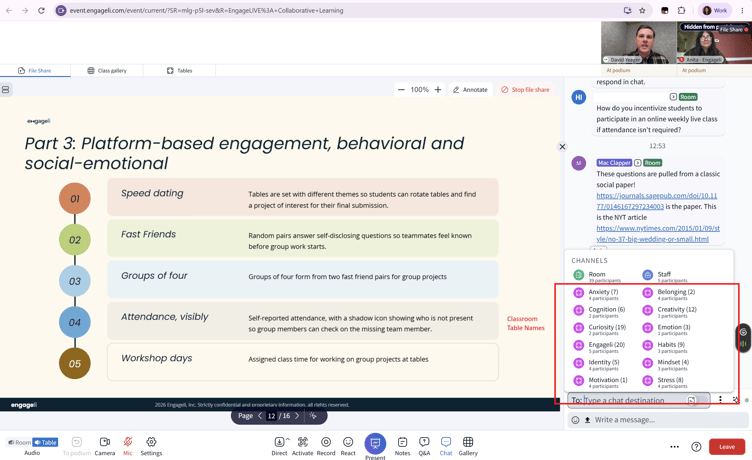
- Build belonging before demanding participation. In the first week, students take part in a structured “Fast Friends” exercise based on social psychologist Arthur Aron's research on interpersonal closeness. Pairs later become groups of four, establish norms such as “take space, make space,” and talk explicitly about behaviors and personal experiences that might have otherwise made collaboration harder.
- Notice when someone disappears. Students also share contact information. If someone misses class, peers are encouraged to reach out first, not with a punitive message, but with a simple signal that their contribution was noticed and missed. Repeated absences can then escalate to a TA or instructor.
Seen together, these practices point to a different philosophy of engagement. Participation isn't something an instructor asks for at the end of a lecture. It is built into every moment of the class.
Technology Matters When Online Participation Has to Scale
An instructor can ask an open-ended question, create small groups, or invite simultaneous responses in many different ways. The challenge appears when those practices have to work consistently across dozens or hundreds of students.
How do instructors know whether everyone contributed? How do teaching assistants monitor multiple groups? How do you surface answers quickly enough to respond while the discussion is still happening? And how do you identify students who are participating less over time, rather than relying on memory or on whoever happens to speak the loudest?
This is where the design of the online learning environment becomes important. In Dr. Yeager's implementation, Engageli's persistent tables support small-group discussion, real-time chat makes large-scale responses visible, and participation data gives the instructional team a clearer picture of engagement across the class. Together, these interactions create a digital engagement footprint, making otherwise invisible learning behaviors visible and giving instructors actionable insight into who is participating, how they are participating, and where additional support may be needed.
Technology isn't the pedagogy. But it can make good pedagogy much easier to execute and scale.
What This Approach Requires
It is also important not to oversimplify what Dr. Yeager has built.
His course benefits from seven paid undergraduate teaching assistants who help review responses and provide feedback. (In the absence of teaching assistants, a classroom AI chat assistant can quickly summarize responses to remove the cognitive overload on the instructor.) The class invests time early in the semester establishing relationships and group norms. And the teaching team follows a deliberately structured rhythm instead of allowing every discussion to run indefinitely.
A single instructor can leverage the model with supporting technology. The core principles are much more transferable:
- Reduce the social cost of answering. Give students time to think together before responding individually, and require everyone, not just the most confident students, to commit to an idea.
- Make correction normal and design the class so that participation is visible rather than assumed.
- Leverage small group discussion frequently during class time.
Why This Matters Beyond One Classroom
Dr. Yeager's class delivery example comes from an undergraduate course, but the design principle extends beyond higher education.
A similar dynamic can appear in a virtual K–12 classroom when a few students answer every question while everyone else remains silent. It can happen in corporate learning when new employees sit through training but are never asked to apply what they have heard. And it can happen in any learning environment where participation depends primarily on who is willing to speak first.
The specific routines will change by audience. The underlying question is the same: does the learning environment make it easier or harder for every learner to think out loud?
The Takeaway
When students are quiet, the natural question is often: did they understand the material? That remains an important question.
But Dr. Yeager's work suggests another one is worth asking alongside it: what did participating require socially?
If answering means being the first person to speak, risking a public mistake, or competing with faster and more confident classmates, silence may tell us as much about the structure of the classroom as it does about the student.
The good news is that structure can change. Sometimes the most powerful way to increase participation isn't a better incentive or a better slide deck. It's designing a learning environment in which more students have a safe, structured reason to think, respond, and try again.
Key Takeaways
• Student silence does not always indicate a lack of understanding. Social risk can also discourage participation.
• Dr. David Yeager's undergraduate course reports approximately 95% attendance and 95% chat participation using structured participation routines.
• Techniques such as simultaneous “waterfall” responses can reduce the pressure associated with answering first.
• Persistent small groups, belonging routines, repeated opportunities to respond, and normalized correction make participation part of the classroom design.
• Technology can help instructors execute these practices consistently and make engagement more visible at scale.
• Dr. Yeager's implementation requires meaningful instructional support, but many of the underlying design principles can be adapted to other learning environments.
Frequently Asked Questions
Do I need seven teaching assistants to use this approach?
No. Seven TAs are part of Dr. Yeager's specific implementation and allow his course to process a large volume of responses quickly. The underlying practices of open-ended prompts, small-group discussion, simultaneous responses, and structured feedback can be adapted for classes with less staff support.
What is a “waterfall” response?
A waterfall is a chat technique in which participants type their answers independently and wait to submit them until the same moment. This reduces the opportunity to anchor on someone else's response and removes some of the pressure associated with answering first.
Does this only apply to higher education?
The routines described here come from an undergraduate course, so they should not be assumed to work identically in every environment. However, the broader design principle, reducing unnecessary social risk and creating structured opportunities for everyone to participate, can be adapted for K–12 classrooms, higher education, and workplace learning.
Is technology required?
Yes, in practice. The underlying instructional principles can be described without it, but technology becomes critical when instructors need to coordinate small-group participation in the same space, gather responses from many learners simultaneously, provide feedback, and see engagement patterns at scale.
References
Aron, A., Melinat, E., Aron, E. N., Vallone, R. D., & Bator, R. J. (1997). “The Experimental Generation of Interpersonal Closeness: A Procedure and Some Preliminary Findings.” Personality and Social Psychology Bulletin, 23(4), 363-377.
Yeager, D. (2024). 10 to 25: The Science of Motivating Young People. Avid Reader Press.
Engageli webinar with Dr. David Yeager, “Beyond the Lecture,” September 15, 2026.