

In corporate training, reporting is often treated as the final administrative step. A program is delivered, an attendance report is exported, a feedback survey is shared, and the client receives confirmation that the work has been completed.
But the expectations placed on training providers are changing.
Clients no longer want to know only whether delegates were invited, or whether they appeared on a register. They want to understand whether people actually attended, whether they participated, and whether the training experience created meaningful engagement.
This creates a challenge for providers using traditional video conferencing tools, and even for providers delivering face-to-face training. Attendance can be captured, but the richer story of learner engagement is often difficult to evidence. A trainer may know that a group discussion was strong, that some delegates contributed thoughtfully, or that others seemed quiet but attentive. Yet much of that insight disappears once the session ends.
Engageli closes that gap. By capturing data from the learner engagement analytics that happen inside the learning environment, training providers can deliver a more complete, evidence-based view of delegate participation.
Moving Beyond the Attendance Register
Attendance is still important. For many corporate clients, it is the first thing they need to know. Who attended? Who missed the session? Who completed enough of the training to be counted as present?
But attendance is no longer enough on its own.
Engageli's attendance analytics can show learner presence across both live sessions and recordings. Attendance can be viewed for live participation, Playback Room viewing, or combined attendance across both. This matters because a delegate may attend part of a session live and complete the rest asynchronously through the recording. Engageli can bring those experiences together when calculating whether the learner met the configured attendance requirement.
For corporate training providers, this is a real shift.
Instead of reporting simply that a delegate joined a meeting, providers can give clients a more accurate picture of whether the delegate was present for enough of the learning experience. They can report attendance by session, by recording, by individual learner, and across a date range. Attendance becomes more than a binary yes or no. It becomes part of a fuller view of how delegates engaged with the program.
This is especially valuable for training that carries compliance, onboarding, certification, or professional development requirements. In those contexts, clients need confidence that attendance has been measured consistently and that asynchronous completion is not invisible.
Understanding Engagement in More Than One Form
One of the most persistent problems in training evaluation is that engagement is often reduced to the most visible behaviors.
In a face-to-face room, the most vocal delegates may appear to be the most engaged. In a video call, the person with their camera on may appear more present than someone who contributes through chat. In both cases, the picture can be incomplete.
Engageli allows providers to look at engagement across multiple dimensions.
The analytics area includes data for attendance, polls, camera time, speaking time, hand raises, chat, notes, reactions, and modules. These categories matter because different delegates participate in different ways. Some will speak regularly. Some will contribute through table discussion. Some will respond to polls or quizzes. Others may engage by taking notes, using reactions, or participating in chat.
Corporate training analytics helps providers avoid a narrow definition of engagement.
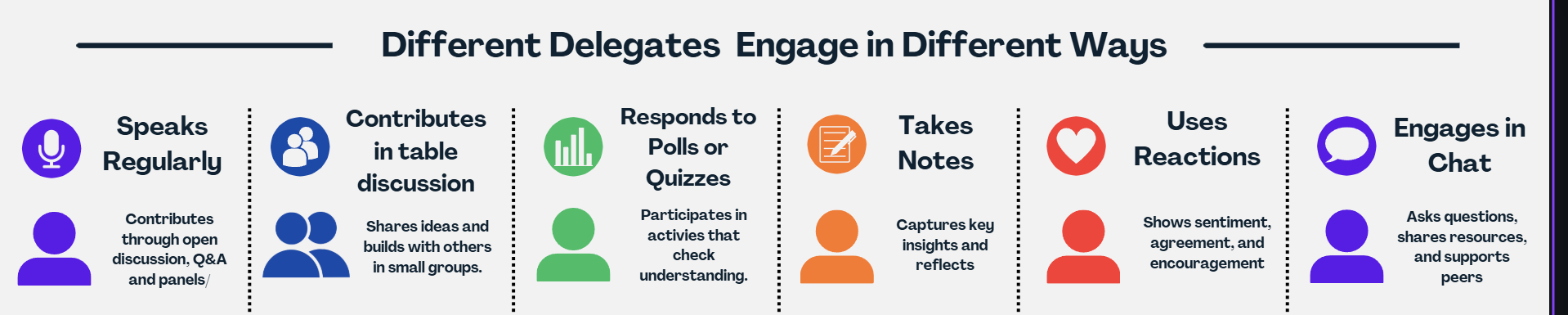
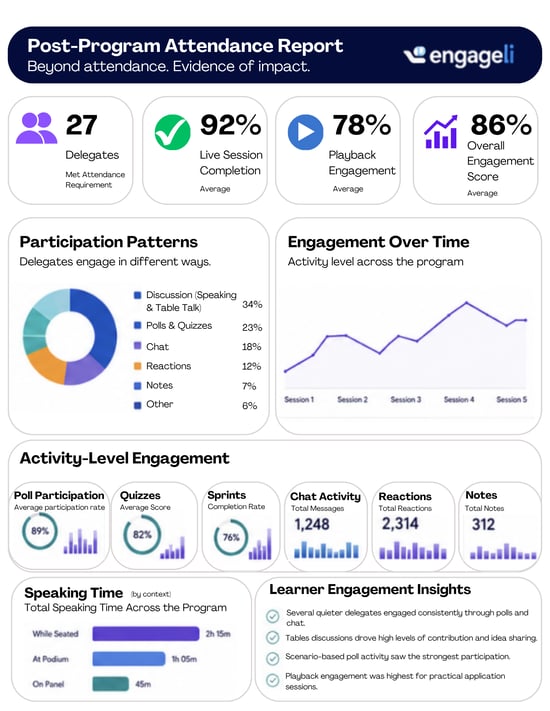
Speaking time, for example, can be reviewed by session and by learner. It can distinguish between different contexts, including speaking while seated, speaking at the podium, and speaking on a panel. Chat analytics can show the number of messages sent across the room, table, staff, and private channels. Poll analytics can show participation rates across action-tag polls, Quick Polls, Polls, Quizzes, and Sprints.
For a client, this creates a much richer report.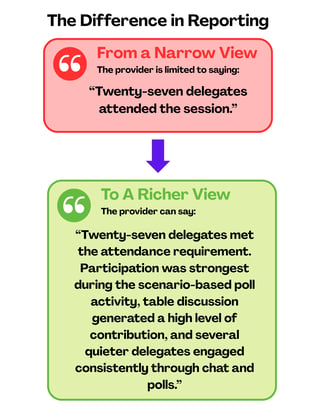
The provider is no longer limited to saying: "Twenty-seven delegates attended the session."
They can say: "Twenty-seven delegates met the attendance requirement. Participation was strongest during the scenario-based poll activity, table discussion generated a high level of contribution, and several quieter delegates engaged consistently through chat and polls."
That is a different kind of client conversation. It is not just proof of delivery. It is evidence of learning design in action.
Making Asynchronous Learning Visible
Corporate training increasingly happens across mixed patterns of participation. Delegates are busy. Some attend live, some watch later, and some do both. Traditional reporting can struggle with this because live attendance and recording access are often treated as separate activities.
Engageli's Playback Room makes asynchronous engagement part of the learning environment rather than an afterthought. Learners can revisit recordings of live sessions or complete modules, and the Playback Room is designed to support active participation rather than passive video watching.
This matters for training providers because client reporting can include the learning that happens after the live session ends.
A delegate who misses the live workshop but completes the recording should not disappear from the evidence base. Equally, a delegate who attends only part of the live session but completes the rest later should be represented more accurately than a simple absence or partial attendance marker would allow.
Engageli's combined attendance view helps providers report this more fairly and more usefully. It supports a more flexible model of corporate learning, where the question is not only "Were they there at the scheduled time?" but "Did they complete the learning experience?"
For clients managing distributed teams, global cohorts, or high-pressure operational environments, this is a major improvement. It allows training providers to support flexibility without losing accountability.
From Session Reports to Program Insight
The most valuable reporting is not always at the level of a single session.
Many corporate training providers deliver programs over time: leadership academies, customer education journeys, onboarding pathways, partner enablement, product training, or certification programs. In these cases, the bigger question is not only what happened in one workshop, but what patterns are emerging across the whole program.
Engageli learner engagement analytics can help providers answer those questions.
Class Portal analytics can be viewed across categories and exported. The export can consolidate analytics for Attendance, Camera, Speaking Time, Polls, Raise Hand, Chat, Notes, and Reactions into a single file, with filters for date range, participant type, and user status. Quiz reports can also provide granular details, including individual questions, participant responses, and whether answers were correct.
For providers working at scale, Engageli's API also supports secure data retrieval, making it possible to bring attendance and engagement data into dashboards, reporting workflows, client packs, and internal quality processes.
This opens up a much broader reporting model.
Training providers can build dashboards, client reports, renewal packs, quality reviews, and program improvement processes around real participation data. They can identify which sessions created the most interaction, which activities prompted the strongest response, which cohorts were most consistent, and where engagement dropped.
That insight is difficult to generate from standard video conferencing tools. It is also difficult to capture consistently from face-to-face delivery, where the trainer's judgment is valuable but not always easy to aggregate, compare, or report.
Strengthening the Client Relationship
For training providers, better data is not just an operational improvement. It is a commercial advantage.
Clients want confidence that training budgets are being used well. They want evidence that delegates did more than attend passively. They want to understand where programs are working, where learners may need follow-up, and how future delivery can be improved.
Engageli's engagement analytics helps providers bring that evidence into the relationship.
People Untapped, a leadership development provider running global cohorts with Engageli, used engagement analytics to evidence a 21-point lift in matrix leadership skills across more than 1,200 learners. That kind of outcome is difficult to demonstrate from an attendance register alone.
A post-program report can move beyond attendance tables and satisfaction scores. It can include patterns of participation, completion across live and Playback Room learning, activity-level engagement, and evidence from polls, quizzes, Sprints, chat, reactions, notes, and speaking time.
Corporate training reports give providers a stronger basis for recommendations.
They can advise clients on program design, session format, cohort support, and follow-up actions. They can show whether interactive elements were used effectively. They can identify whether learners engaged more through discussion, polls, chat, or asynchronous playback. They can use data to support the trainer's professional judgment, rather than replacing it.
This is the key point. Data does not remove the human element from training. It gives trainers, program managers, and client stakeholders a clearer shared view of what happened.
Looking Ahead
The future of corporate training reporting will not be defined by static attendance registers. It will be shaped by connected insight: who attended, how they participated, how they completed the learning experience, and what those patterns reveal about the design and impact of the program.
Engageli sits at the center of this shift.
For training providers, it turns everyday learning interactions into meaningful data. For clients, it creates a more transparent view of delegate engagement. And for both, it opens the door to better conversations about value, quality, and improvement.
The question is no longer simply: "Did the delegates attend?"
It is: "How did they engage, what did we learn from that engagement, and how can we use it to make the next program even stronger?"
Ready to see how Engageli helps training providers report engagement, not just attendance? Book a demo or download the Active Learning Impact Study to see what's possible when engagement data becomes part of every client conversation.
Frequently Asked Questions
How can training providers use learner engagement analytics to strengthen client relationships?
Engageli's engagement analytics enables training providers to deliver evidence-based reports that show different dimensions of engagement during the sessions. By showing participation patterns through activity-specific insights, training providers can offer clients a richer view of how learners engaged and where the program can be refined.
Can Engageli analytics be integrated into clients' existing systems?
Yes. Engageli provides exportable reports and secure API access, allowing training providers to incorporate attendance and engagement data into existing dashboards, reporting workflows, client reports, and business intelligence tools to provide a more comprehensive overview of training delivery.
How can engagement data help improve future training programs?
Engagement data helps identify which activities generated the highest levels of participation, when learners disengaged, and the overall engagement patterns across the sessions. These insights enable training providers and clients to refine program design, improve facilitation strategies, and make data-informed decisions that enhance future learning outcomes.
Can Engageli support reporting for asynchronous learning?
Yes. Engageli captures engagement and attendance data from both live sessions and Playback Room activity. This allows training providers to include asynchronous participation in client reports and provide a more accurate picture of learner completion and engagement. It also lets participants engage with immersive learning content on their own schedule.