

AI has given corporate L&D teams more ways to create content, personalize learning, support employees in the flow of work, and deliver training at scale. That has also created a tempting assumption: if AI can make self-paced learning better and provide information round the clock, perhaps organizations need less live training.
The evidence emerging in 2025 and 2026 points to a more complicated picture.
LinkedIn’s 2025 Workplace Learning Report found that 71 percent of learning and talent development professionals were already exploring, experimenting with, or integrating AI into their work. Yet the same report shows organizations continuing to invest in leadership training, coaching, project-based learning, and other experiences built around human interaction. Seventy-one percent of organizations surveyed offered leadership training.
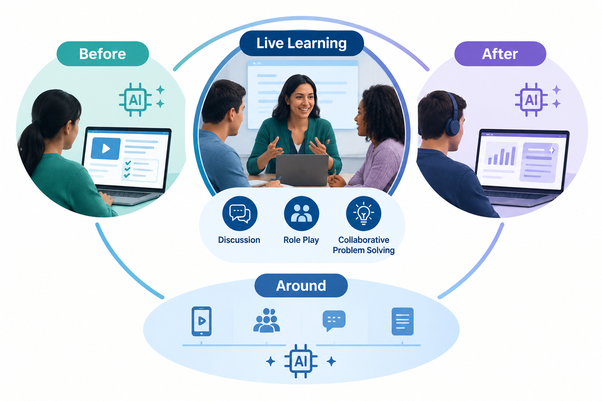
The question for L&D is no longer whether AI belongs in corporate learning. It clearly does. The more useful question is where AI is the right learning experience and where people still need to learn with an instructor and with each other.
Is virtual instructor-led training still relevant in the age of AI?
Virtual instructor-led training, or VILT, is live online training led by a facilitator in real time. Unlike self-paced learning, it gives participants an opportunity to ask questions, discuss ideas, practice skills, solve problems with colleagues, and receive feedback during the learning experience.
Those capabilities become particularly important when the objective goes beyond transferring information.
AI can explain a sales methodology. A facilitator can ask a sales team to use it in a difficult customer conversation and then challenge how they responded. AI can summarize a leadership framework. A live session can give managers an opportunity to debate how that framework should be applied when the situation is ambiguous.
That does not mean every course needs a live instructor. Product information, compliance refreshers, reference material, and foundational knowledge can often be delivered effectively without scheduling a live session.
But judgment, collaboration, communication, practice, and feedback are different learning problems. Treating every training requirement as a content-delivery problem risks losing exactly the interaction that makes some forms of learning useful.
Recent ATD research reinforces that instructor-led learning has not disappeared as AI adoption increases. Its 2026 State of the Industry report, based on 2025 talent development benchmarks, lists both instructor-led virtual classrooms and traditional instructor-led classrooms among the delivery methods organizations continue to use.
Where does AI actually fit into corporate training?
The stronger model is not AI versus instructor-led training. It is deciding what each should do.
AI can make the individual parts of learning faster and more adaptive. It can help employees quickly find answers, generate practice material, review concepts, prepare for a live session, assist with writing, and continue learning after it ends.
Live training can concentrate on what benefits from human interaction: discussion, role play, collaborative problem solving, feedback, decision-making, and learning from other people's experiences.
LinkedIn’s 2025 research is useful here because it does not present AI adoption and human development as competing strategies. Organizations identified as more mature in career development were 32 percent more likely to be deploying AI training programs, while also investing in in-person practices such as leadership development, coaching, internal mobility, and project-based learning.
That is a more realistic picture of where corporate learning is heading. AI expands what can happen before, after, and around live learning. It does not automatically eliminate the reasons for bringing people together.
Why is the harder VILT conversation often about budget, not learning?
This is where the challenge becomes less pedagogical and more organizational.
Engageli’s buying-committee research across corporate accounts has repeatedly surfaced a familiar objection: the organization already pays for Microsoft Teams or another enterprise meeting platform.
For IT, that is a reasonable question. If a company already has software for video meetings, why should it pay for another platform that also happens to use video?
The answer cannot simply be that a dedicated virtual training platform is more engaging.
ATD’s 2026 State of the Industry research found that talent development professionals remain concerned about securing the financial resources required for future learning initiatives. That means L&D teams are operating in an environment where demonstrating value matters as much as demonstrating learning potential.
A VILT business case therefore needs to answer a different question: what does the training organization need to accomplish that its meeting technology does not adequately support?
What is the difference between a meeting platform and a virtual training platform?
A meeting platform is designed primarily for communication. A virtual training platform is designed around the activities that happen while people are learning.
The distinction becomes clearer when a facilitator needs participants to move between instruction, small-group collaboration, practice, discussion, and feedback during the same session.
In a conventional meeting platform, the facilitator may be responsible for creating breakout rooms, moving learners between them, checking multiple rooms, monitoring chat, running polls, watching participation, and trying to determine who understands the material.
The technology works, but much of the learning orchestration still sits with the instructor.
A platform designed specifically for virtual instructor-led training can structure more of that experience around learning itself. Persistent small groups, participation data, collaborative activities, and instructor visibility can make it easier to run a session where learners spend more time doing something with the material rather than simply watching someone present it.
That is a more useful distinction for an IT buyer than describing the platform as a better version of Zoom or Teams.
What should L&D measure instead of attendance?
One of the biggest risks in virtual training is confusing presence with participation.
A participant can join a session, remain connected for an hour, and complete the training without saying anything, answering a question, contributing to a discussion, or demonstrating that they can apply what they learned.
For L&D teams under pressure to connect learning investments to business outcomes, completion data alone is increasingly difficult to defend.
LinkedIn’s 2025 Workplace Learning Report explicitly recommends connecting learning investments to organizational objectives such as productivity, profitability, retention, and risk reduction rather than relying only on traditional activity measures. Its research found that employee engagement and retention remain common measures of career-development impact, while urging L&D leaders to move closer to business outcomes.
For VILT, that can mean looking beyond whether someone joined the session. Depending on the program, more useful indicators might include participation, skill demonstration, proficiency, learner confidence, onboarding progress, assessment results, or changes in performance after training.
What happens when the virtual classroom is designed around participation?
People Untapped, an Engageli corporate customer, reported an 11-point increase in Net Promoter Score after moving its live training onto Engageli.
That is one customer result, not a benchmark for every organization, and it should be treated accordingly. But it illustrates an important point: the environment in which live training happens can influence how participants experience the program.
The technology is not the pedagogy. A poorly designed training session will not become effective simply because it runs on a different platform but technology can make better pedagogy easier to execute.
When learners can move naturally between facilitator-led instruction, small-group discussion, practice, and reflection, and when instructors can see what is happening across those activities, virtual training begins to operate more like a learning environment and less like a meeting with educational content added to it.
What should corporate L&D teams do differently in 2026?
The first change is to stop treating AI and live training as competing categories.
Use AI where personalization, speed, reinforcement, content generation, or independent practice creates value. Use virtual instructor-led training where learners need human discussion, feedback, collaboration, practice, or facilitated decision-making.
The second change is to involve IT before the procurement conversation becomes a request for another technology subscription. Define the learning problem first. Identify what the current meeting environment cannot support. Connect the proposed investment to an outcome the organization already cares about.
Another shift is toward departmental autonomy, with L&D teams receiving their own budgets and greater decision-making authority over training program design and delivery.
Finally, measure whether learners are actually doing something with what they are learning.
Corporate learning does not need to become less human because AI has become more capable. It needs to become more deliberate about where human interaction matters.
That is the opportunity for virtual instructor-led training in 2026: not to compete with AI, but to do the part of learning that AI alone cannot replace.
Frequently Asked Questions
What is virtual instructor-led training?
Virtual instructor-led training, or VILT, is live online training delivered by a facilitator in real time. Participants can interact with the instructor and other learners through discussion, collaborative exercises, practice, questions, and feedback.
Will AI replace instructor-led corporate training?
Current evidence does not support that conclusion. Organizations are rapidly adopting AI for learning while continuing to invest in instructor-led training, leadership development, coaching, and collaborative learning. The more likely model is a combination of AI-enabled individual learning and facilitated human learning.
What is the difference between VILT and a webinar?
A webinar is generally built around a one way model of presenting information to an audience. VILT is structured as a learning experience and can include discussion, group work, practice, assessment, feedback, and instructor interaction.
Why use a virtual training platform instead of Microsoft Teams or Zoom?
Teams and Zoom can support virtual training. They provide the basic tools for delivering instructor-led sessions, including video conferencing, screen sharing, presentations, chat, polls. A dedicated virtual training platform becomes relevant when the learning model requires more structured small-group collaboration, instructor visibility, participation data, learning activities, or training-specific analytics than a general meeting environment provides.For training that requires measurable learning outcomes, organizations may need a purpose-built virtual classroom that goes beyond meetings to support structured learning activities and engagement analytics.