AI tutoring

personalized for every student


Engageli's AI tutors deliver personalized, always-available learning support that empowers every learner to succeed at their own pace.


Untitled design (10)


Turning questions into understanding

smarter-learning-icon-500
Smarter learning

Learner questions are analyzed through Natural Language Processing, enabling interpretation of the learner’s intent even when the wording is partial or imprecise.
contextual-learning-icon-500
Contextual learning

By referencing designated source materials, Engageli's AI tutor delivers explanations that stay aligned with the taught content.

outcome-based-learning-icon-500
Outcome-based learning

Using an AI-powered question framework, Engageli's AI tutor generates alternative explanations to help close learner knowledge gaps for targeted outcomes.


Subheading

Intelligent tutoring


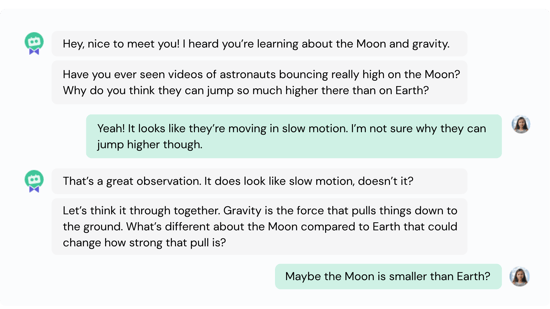
Engageli’s Socratic AI tutor guides learners to discover the answer  themselves through smaller, structured questions instead of simply providing it. As learners respond, the tutor identifies where they may be struggling and offers targeted explanations, examples, or scaffolding to bridge those knowledge gaps.


At the same time, every response is grounded in defined source materials. Using Retrieval-Augmented Generation, the tutor pulls from trusted content before generating an answer, ensuring guidance is both accurate and aligned to the lesson.

Deeper understanding


By making inferences, Engagei's tutor can connect ideas across source materials and explain underlying foundational concepts, helping learners move from memorization to comprehension. Learners can also access the exact source materials used, making it easy to review and deepen understanding.


Subheading (2)


Subheading (1)


Real-world connections


Engageli's tutor assesses knowledge using application of concepts to new problems and scenarios, instead of recall questions. The question pattern and content connection is drawn from the AI framework powering the tutor. The conversation history is available to instructors for review.

Ready to see Engageli in action?

Speak to our team of educators to see how Engageli's virtual classroom improves outcomes while giving instructors real-time visibility into engagement.

bg1

Got questions? We’ve got answers.

AI tutoring is conversational, 1:1 learning support delivered by an AI assistant, the learner asks questions in natural language and gets immediate, specific answers. Good AI tutors don't just answer; they also ask the learner questions back to reinforce retention.

There are three common forms of AI tutoring today: general chatbots like ChatGPT (knowledgeable but not course-specific), subject-specific consumer apps for things like math or language learning (narrow but polished), and course-content-aware AI tutors embedded inside a learning platform. Engageli's Learning Pal is the third kind. It lives inside the Engageli classroom, Playback Rooms and Studio modules, and pulls from the instructor's actual course content rather than the open web.
Five benefits that make AI tutoring worth integrating into a learning program:

1. 24/7 availability. Learners with questions at 10pm don't have to wait until next class, or give up.

2. 1:1 at scale. No single instructor can answer every learner's question in real time. AI tutoring covers the gap without requiring one-to-one staffing.

3. Just-in-time support. Confusion caught and resolved immediately doesn't compound into broader knowledge gaps by week three.

4. Consistent quality. AI tutors don't have bad days. The 1,000th learner gets the same quality of explanation as the first.

5. Engagement data. AI tutoring sessions are logged and analyzed alongside the rest of the learning data. Instructors can see not just who engaged, but what they were confused about.
For some things, yes. For other things, no.

AI tutoring is effective at: immediate answers to content-specific questions, retrieval practice through AI-generated questions back to learners, 24/7 concept clarification, and reducing the lag between learner confusion and resolution. These are places where AI reliably outperforms the status quo of 'wait for office hours.'

AI tutoring is not effective at: complex mentorship, judgment calls, evaluating learner work, building long-term relationships, or replacing peer discussion and collaboration. These need humans.

Engageli's active learning research shows that learners engaged in active content produce 54% higher test scores than learners in passive sessions. AI tutoring is one of the tools that makes async and self-paced content active rather than passive, it's part of why the outcomes hold up in modalities where they normally don't.
Five criteria that separate serious AI tutoring platforms from bolt-on chatbots:

1. Course-content-aware AI. The tutor should draw from your actual curriculum, not the open web. This is the single biggest factor in avoiding hallucination and maintaining academic integrity.

2. Instructor control. Educators should be able to configure what the AI can and cannot do, per course. If the platform treats the AI as an always-on black box, that's a problem.

3. Integration with the classroom. AI tutoring should live inside the same platform as live sessions, async review, engagement analytics, and peer collaboration. A separate tool creates a fragmented learner experience and fragmented data.

4. Data privacy guarantees. Student conversations with the AI should not be used to train models. The platform should document this clearly and contract it formally.

5. Analytics on AI interactions. You should be able to see who used AI support, what they asked, and how it shaped their engagement, not just a completion checkbox.
bg2