

Gamification in education applies game mechanics like points, leaderboards, and competitive formats to learning activities. Meta-analyses consistently find moderate-to-large effects on learning outcomes (g = 0.49–0.82). The approach works across K-12, higher education, and corporate training, but only when mechanics are tied to learning objectives. Superficial implementations backfire. This guide covers the research, the strategies, the mistakes, and how platforms like Engageli bring gamification into both live and asynchronous learning.
Table of contents
What is gamification in education?
Gamification in education is the practice of applying game design elements and mechanics to learning activities. Points, badges, leaderboards, progress bars, competitive challenges, and reward systems are layered onto educational content to increase motivation, deepen engagement, and improve learning outcomes. It is distinct from game-based learning, where the game itself is the learning activity.
That distinction trips people up constantly. In faculty meetings, in product demos, in conference breakout sessions where someone proposes making things “more game-like” without specifying what they mean. So here is the simplest version: gamification takes an existing lesson, module, or training session and adds game mechanics on top. A timed quiz competition during a lecture is gamification. Game-based learning, by contrast, places the educational content inside a game environment. A history simulation where students role-play as world leaders is game-based learning. They have overlapping research, but different design decisions.
| Gamification | Game-based learning | |
| Approach | Adds game elements to existing content | Embeds learning inside a game |
| Example | Leaderboard quiz during a lecture | Historical role-play simulation |
| Instructor role | Designs rules, runs competition | Facilitates gameplay |
| Best for | Motivation, review, formative assessment | Deep exploration, critical thinking |
| Typical duration | 5–15 minutes within a session | Full session or multi-session |
For a deeper comparison, see Gamification vs. Game-Based Learning: What’s the Difference? on the Engageli blog.
Effective gamification rests on three psychological principles rooted in self-determination theory [1]:
-
Autonomy: learners persist when they feel in control of their choices.
-
Competence: completing challenges at the right difficulty level builds a sense of mastery.
-
Relatedness: social connection and team-based formats deepen engagement.
Michelle Schwartz at Toronto Metropolitan University adapted these into a practical framework for higher education, swapping relatedness for value, an emphasis on real-world relevance that resonates particularly with adult learners [2]. When gamification satisfies these needs, it works. When it ignores them, you can get points without purpose.
Does gamification actually improve learning? What the research says
Short answer: yes, with a meaningful effect size and a deep evidence base. The longer answer is where the useful details live, because the research also tells you exactly when it doesn’t work and why.
Sailer and Homner’s 2020 meta-analysis in Educational Psychology Review examined 40 experiments and found a moderate effect on cognitive learning outcomes (Hedges’ g = 0.49) [3]. To put that in classroom terms, that is roughly equivalent to moving a student from the 50th percentile to the 69th. Motivational outcomes showed a similar pattern (g = 0.36), and behavioral outcomes were smaller but still positive (g = 0.25).
More recent analyses found even larger effects. Li and colleagues published a 2023 meta-analysis in Frontiers in Psychology covering 41 studies with over 5,000 participants and reported an overall effect of g = 0.822 [4]. That is a large effect by any standard. Zeng and colleagues in the British Journal of Educational Technology found g = 0.782 for academic performance across 22 experimental studies [5]. And a 2025 meta-analysis by Kurnaz and Koçtürk in Psychology in the Schools found g = 0.654 for K-12 student motivation across 31 studies [6].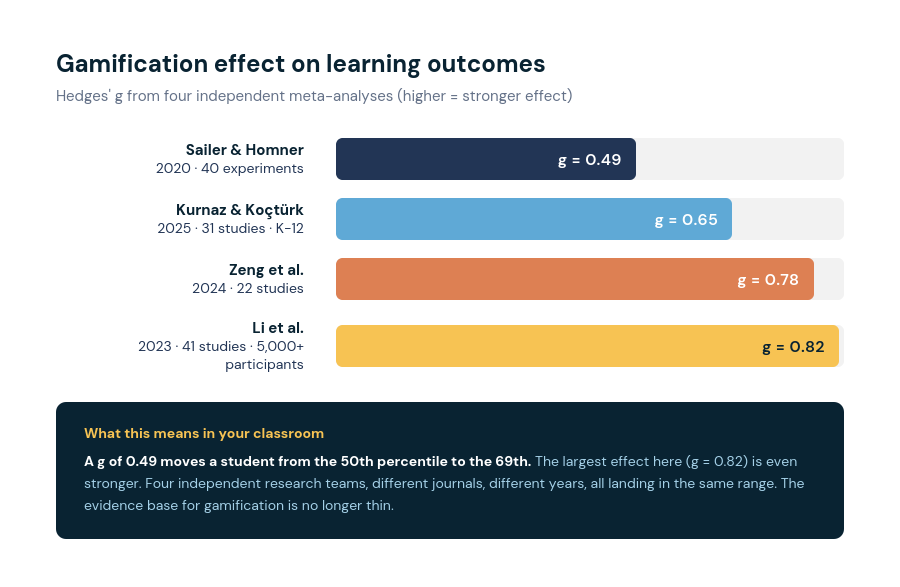
Four independent research teams with different inclusion criteria, journals, and years. All landing in the same g = 0.49–0.82 range. The evidence base is no longer thin. Gamification produces moderate-to-large improvements in learning outcomes when implemented with intention.
What does “with intention” mean, practically? It means the game mechanics are tied to learning objectives, the difficulty pushes students just enough, and the competitive or progress-based elements serve the content rather than decorating it. The same literature that shows strong positive effects also documents implementation failures. Those failures trace back to a specific design problem covered later in this guide.
Outside the classroom, corporate training also tells a consistent story. The Deloitte Leadership Academy implemented gamification for 10,000+ senior executives in 2012 through a partnership with Badgeville. The results: a 37% increase in weekly returning users and a 50% reduction in the time required to complete training curricula [7][8]. TalentLMS surveyed approximately 900 employees and found that 83% of those receiving gamified training felt motivated, compared to just 28% in non-gamified environments [9]. Among the non-gamified group, 61% reported feeling bored and unproductive. The gap is hard to ignore.
Engageli’s own data reinforces this. The Active Learning Impact Study found 13x more learner talk time in active sessions versus passive lecture, 62.7% participation rates compared to 5% in traditional formats, and 54% higher test scores [10]. These numbers reflect the broader active learning context that gamification plugs into: when students are doing something rather than watching something, learning improves. Gamification gives you a structured, repeatable way to make that happen.
Types of gamification in education
Gamification is not one thing. The mechanics you choose shape the learning experience in specific ways, and different types serve different goals. Here are the four primary categories.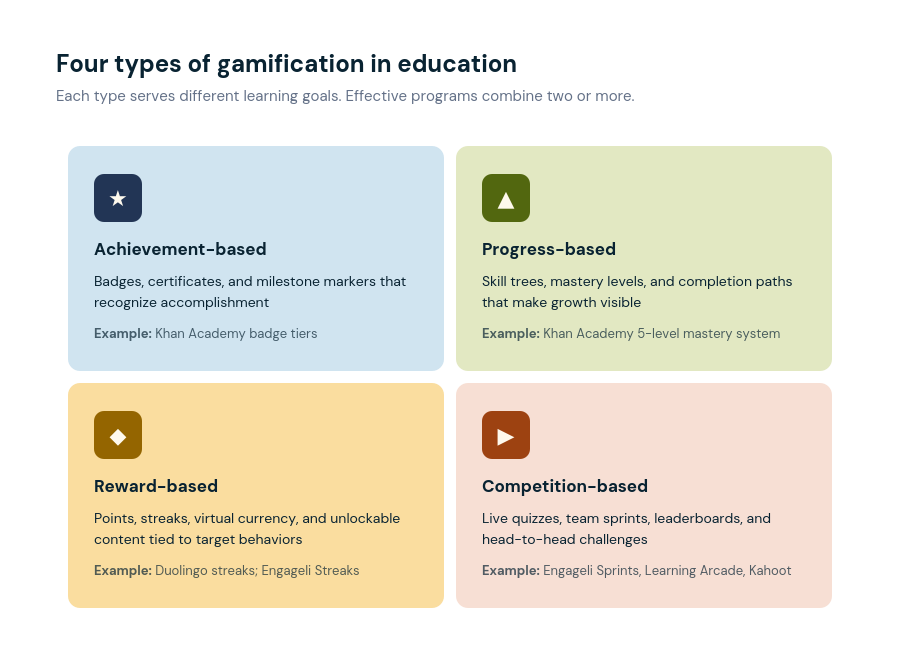
Achievement-based gamification
Badges, certificates, and milestone markers that recognize accomplishment. For example, Khan Academy’s badge system uses celestially themed tiers from Meteorite through Black Hole, tying each badge to genuine mastery milestones rather than simple participation [11]. The design principle: make progress visible and make accomplishment feel earned. Badges connected to meaningful learning milestones reinforce competence.
Progress-based gamification
Skill trees, completion bars, mastery levels, and learning paths. Khan Academy’s five-level mastery system (Not Started, Attempted, Familiar, Proficient, Mastered) requires demonstrated competence before advancement [11]. Students see exactly where they stand and what gap remains. This draws on James Paul Gee’s work on learning principles in game design, particularly what he calls the Regime of Competence Principle: well-designed games keep players at the edge of their abilities, challenging enough to stretch but achievable enough to sustain effort [12].
Reward-based gamification
Points, virtual currency, unlockable content, and streak systems. Duolingo is the most studied example, with over 50 million daily active users as of Q3 2025 [13]. Its streak counter for consecutive daily practice is the engine: users who maintain a 7-day streak are 3.6x more likely to stay engaged long-term. CEO Luis von Ahn has said that 10 million active users maintain streaks longer than 365 days. The weekly league system (Bronze through Diamond) drives 40% more engagement by giving learners a peer group to compete against. Every reward connects to a specific behavior Duolingo wants to reinforce: daily practice, persistence through difficulty, and course completion. Engageli applies this same streak-based principle to classroom attendance, rewarding the target behavior of continuous presence at lessons.
Competition-based gamification
Live quiz shows, team sprints, ranked challenges, and head-to-head formats. This is the most underrepresented category in both research and content. Kahoot pioneered the live quiz format and has accumulated over 10 billion cumulative participants across 200+ countries [14]. A 2025 meta-analysis found a very large retention effect size of 1.492 for Kahoot-based learning [15]. But most competition tools operate as standalone apps disconnected from the classroom. You run Kahoot in one browser tab, switch to the LMS, switch to the video call. The experience is fragmented, and the data lives in a silo.
That fragmentation is the problem live classroom platforms and async game builders are designed to solve. More on that in the product section below.
Gamification examples in education
Below are six implementations of gamification in education, each representing a fundamentally different approach:
-
Duolingo (streaks and habit formation): The most commercially successful gamification system in education. Daily streaks, XP leaderboards, and the league system have driven 50+ million daily active users. The design lesson: every reward connects to the target behavior (daily practice), and loss aversion (breaking a streak) is as powerful a motivator as earning points [13].
-
Khan Academy (mastery-based progression): A five-level mastery system where competence gates advancement. Students cannot skip ahead by gaming the system. The badge tiers (Meteorite through Black Hole) reward sustained effort, not just correct answers [11].
-
Engageli Learning Arcade (AI-powered async competition): Paste your notes, AI builds the game, share one link. Students compete on their own schedule via streaks, leaderboards, and personal bests.
-
Engageli Sprints (live classroom competition): Timed quiz games with music and leaderboards running inside the live virtual classroom. Every table competes simultaneously while the instructor monitors all groups in real time. Five minutes of Sprint replaces twenty minutes of passive review.
-
Kahoot (K-12 live quiz): The original live quiz platform, now used in 200+ countries with over 10 billion cumulative plays. Best for quick review and formative checks. A 2025 meta-analysis found a very large retention effect size of 1.492 [14][15].
- English Bright ESL gamifies learning through visual progress tracking used in teacher-led ESL classes, allowing learners to see their advancement over time, including vocabulary growth and learning statistics. By visualizing progress, learners gain a sense of accomplishment and motivation as they track their mastery and work toward completing language-learning goals.
-
Classcraft (team-based historical RPG): A classroom RPG where students played as warriors, mages, and healers with team dynamics affecting outcomes. The original platform served 8+ million students in 160+ countries before shutting down in 2024 after HMH’s acquisition [20]. A reminder that deep narrative gamification can work powerfully, but sustainability at scale is its own challenge.
Gamification in Engageli: Learning Arcade, Sprints, and Streaks
Engageli weaves game mechanics into both the live virtual classroom and the asynchronous learning experience. Three features make this work.
 Engageli Learning Arcade
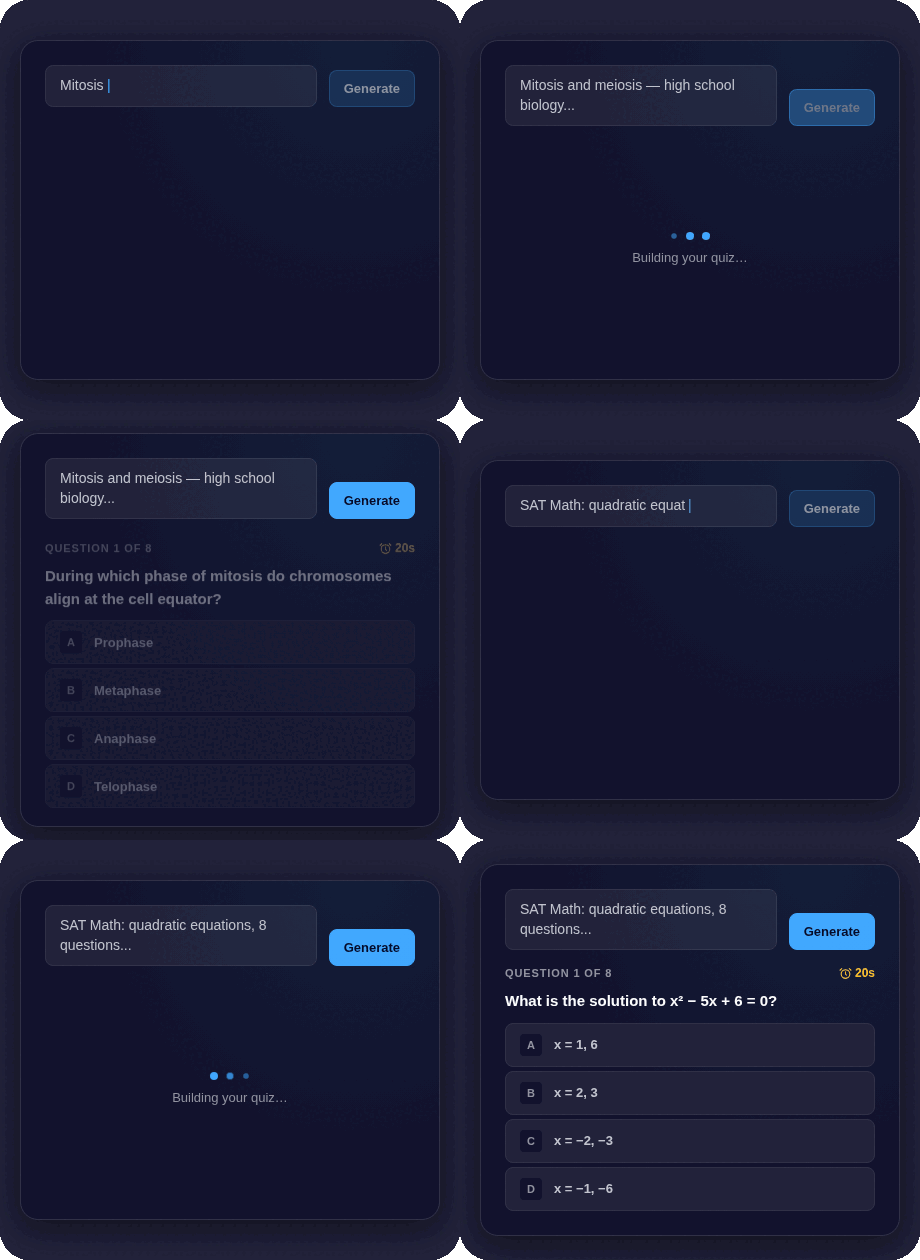
Learning Arcade is an AI-powered async quiz game builder. You paste your notes, upload your slides, or describe a topic. AI generates a full quiz module with questions, answer options, and explanations in under a minute. You review and tweak, then share a single link. Students enter their name and play on any device, on their own schedule, with no accounts and no downloads.
The game mechanics are what make it stick. Streaks reward consecutive correct answers with multiplier bonuses up to 5x, so accuracy under pressure matters. A real-time leaderboard lets students see where they stand against classmates. Personal best tracking and completion badges give students a reason to replay without the social pressure of a public ranking.
For instructors, the AI analytics are where Learning Arcade goes beyond a game. Per-question performance data shows exactly which concepts students missed. An AI-powered “what to reteach” summary gives you a diagnostic before the exam, not after. You drop the link in your LMS, Slack, or Google Classroom, and you get actionable data without building a single question from scratch.
Try playing games today at Engageli Learning Arcade ▶
.png?width=500&height=281&name=Light%20Mode%20UI%20-%20Large%20Size%20(14).png) Sprints
Sprints
Sprints bring gamification into the live classroom session. They turn quizzes into interactive games with music, timers, and live leaderboards that change the energy of a room instantly. If you’ve ever watched a class go from half-engaged to fully locked in the moment you add a countdown timer, you know what this does. Sprints award points for both speed and accuracy, encouraging quick thinking without rewarding guessing.
In Engageli’s virtual classroom, Sprints run for every student simultaneously. The instructor sees all scores and participation in real time and can debrief immediately after, addressing misconceptions that surfaced through incorrect answers. In Playback Rooms, Sprints bring that same competitive energy to asynchronous learning, with leaderboards that let students see how they compare even outside of live sessions.
.png?width=520&height=293&name=Light%20Mode%20UI%20-%20Large%20Size%20(15).png) Streaks (coming soon)
Streaks (coming soon)
Attendance streaks turn showing up into a habit rather than a one-time decision. Learners build consecutive-attendance streaks and see their progress visually. The psychology is the same mechanic that makes Duolingo’s streak system so effective: loss aversion. Once you have a streak going, breaking it feels like losing something. Consistent attendance builds continuity, keeps learners on track, and reduces the kind of gradual drop-off that plagues online courses.
Games you can play with Engageli’s active learning architecture
Beyond these built-in features, Engageli’s classroom architecture enables instructors to run games that would be difficult or impossible on a standard video conferencing platform. Trivia Blast uses Engageli Tables as team pods: table groups collaborate to answer questions within a time limit, using the virtual whiteboard to work through answers together. Name each table with a team name and the competitive energy builds itself. Quiz Show uses the Podium, where students raise their hands to buzz in and the instructor can see the order. It turns a review session into a high-energy competition that motivates quick recall.
These games emerge naturally from a platform designed around small group visibility and real-time interaction. The reason they work is structural: every student is visible, and the transition from game to debrief to instruction happens without switching tools.
See how Engageli’s Learning Arcade, Sprints, and live classroom games work for your students.
Gamification strategies by age and audience
K-12: Grades K–5
Young learners don't need convincing that games are fun. They need games that are actually teaching something. The Li et al. meta-analysis found the largest gamification effect size for elementary students (g = 1.293), which makes sense: younger children respond strongly to novelty, immediate feedback, and visible progress [4]. The opportunity is enormous. The risk is choosing mechanics that entertain without reinforcing learning.
What works at this level looks different from what works with older students. Progress-based systems outperform competition-based ones for K–5. A visual path where students move a character forward as they master skills gives young learners a concrete sense of growth without the social comparison that can discourage early readers or math learners who are still building confidence. Completion badges tied to specific milestones (“I can count to 100”, “I finished all the vowel sounds”, “I came to every class this week”) tap into the pride that drives this age group.
Competition can work, but keep it collaborative. Table-based team challenges where groups work together to solve problems remove the individual spotlight that makes some younger students freeze. In an Engageli classroom, you can run a Trivia Blast where each table collaborates on answers using the whiteboard, building teamwork while practicing recall. The competitive element is table vs. table, not child vs. child, and that distinction matters more than most gamification guides acknowledge.
Two practical considerations for this age group: keep game sessions short (5–8 minutes holds attention better than 15), and minimize login friction. If a student can't remember a password, the game is over before it starts. Tools with link-based access and no account requirements, like Engageli's Learning Arcade, eliminate that barrier entirely. Students enter their name and play.
K-12: Grades 6–12
Most gamification content targets elementary classrooms, and if you teach older students, you already know those approaches don’t transfer cleanly. A seventh grader does not respond to the same mechanics as a second grader. For grades 6–12, competitive formats outperform individual reward systems because adolescent motivation runs on social dynamics and peer perception.
Strategies that consistently work for secondary classrooms:
-
Run timed review competitions where teams race to answer before a countdown expires. The time pressure activates urgency without high stakes.
-
Use quiz competitions at the start of class as retrieval practice, one of the most evidence-backed strategies in cognitive science. Five questions, two minutes, and you’ve done more for long-term retention than a 20-minute review lecture would.
-
Implement team-based challenges where small groups collaborate before competing against other groups. The collaboration builds understanding; the competition builds motivation.
-
Create progression systems across a unit so students can track cumulative growth, not just how they did on a single game.
Tools like Kahoot, Blooket, and Gimkit are popular in K-12 settings. Blooket’s collectible characters and game modes (Tower Defense, Gold Quest) resonate with middle schoolers specifically. Gimkit’s virtual economy, where students spend earned currency on in-game power-ups, adds a strategic layer that keeps older students engaged beyond basic question-and-answer. For asynchronous review and homework, Engageli’s Learning Arcade lets you paste notes or upload slides, have AI generate a full quiz module in under a minute, and share a single link. Students enter their name and play. No accounts, no downloads, no forgotten passwords.
Higher education
Here is something the data shows that most guides miss: gamification actually works better for college students than for secondary school students. Li and colleagues’ 2023 meta-analysis found that higher education users showed a large effect size of g = 0.869, compared to g = 0.014 for secondary school students [4]. The gap is enormous, and it suggests that the competitive and mastery-based mechanics of gamification resonate with the self-directed motivation of adult learners.
What works for college and university faculty: Sprints during lectures break up passive listening and give you instant formative data on who understood what. Quiz challenges at Engageli Tables create social energy that sustains participation through a 90-minute seminar. Async quiz competitions using a tool like Learning Arcade let students review on their own schedule while competing on a leaderboard, turning homework from something students avoid into something they replay. And peer competition with visible rankings motivates students who might otherwise treat asynchronous review as optional.
The integration challenge matters in higher ed. When gamification happens inside the same environment where lecture, discussion, and group work occur, participation stays seamless. When it requires a separate app, a separate login, a separate tab, engagement drops. That is true for live sessions, and it is true for async homework.
Corporate L&D
For L&D directors, the question is rarely whether gamification works for adults. They can feel the energy shift in a room when you add competition. The question is which mechanics produce measurable training outcomes and which ones are just entertainment.
Onboarding sprints compress orientation content into competitive team challenges, accelerating time-to-competency. Sales enablement competitions with leaderboards tap into the existing competitive culture of sales teams while reinforcing product knowledge. Compliance training (notoriously low-engagement) benefits from progress-based gamification where employees unlock subsequent modules by demonstrating mastery. The Deloitte data, along with TalentLMS’s findings on motivation, makes the business case [7][9].
One design point specific to adults that the research keeps surfacing: Koivisto and Hamari found that while ease of use declines with age, older users actually derive more benefit from social and collaborative gamification elements [16]. Teams and shared goals resonate more than individual point accumulation. Landers and Armstrong confirmed in 2019 that attitudes toward games, not age itself, predict whether gamification helps or hurts [17]. A 65-year-old who plays Wordle every morning will respond differently than a 25-year-old who has never touched a game. Know your audience.
What the research says about gamification for adult learners
This section exists because almost every gamification guide skips it. The assumption that gamification is “for kids” persists in planning meetings and curriculum committees. The data tells a different story, and it’s one worth knowing if you teach adults.
Li et al.’s 2023 meta-analysis broke results down by learner type. Elementary students showed the largest effect (g = 1.293), expected since younger students respond strongly to novel stimuli. Higher education users showed g = 0.869 [4]. That is still a large effect. A 2025 Digital Promise policy brief noted that year-over-year persistence for students who begin their studies at age 25 or older is 35 percentage points lower than for younger students [18]. If gamification can close even part of that retention gap, it changes the math on program completion.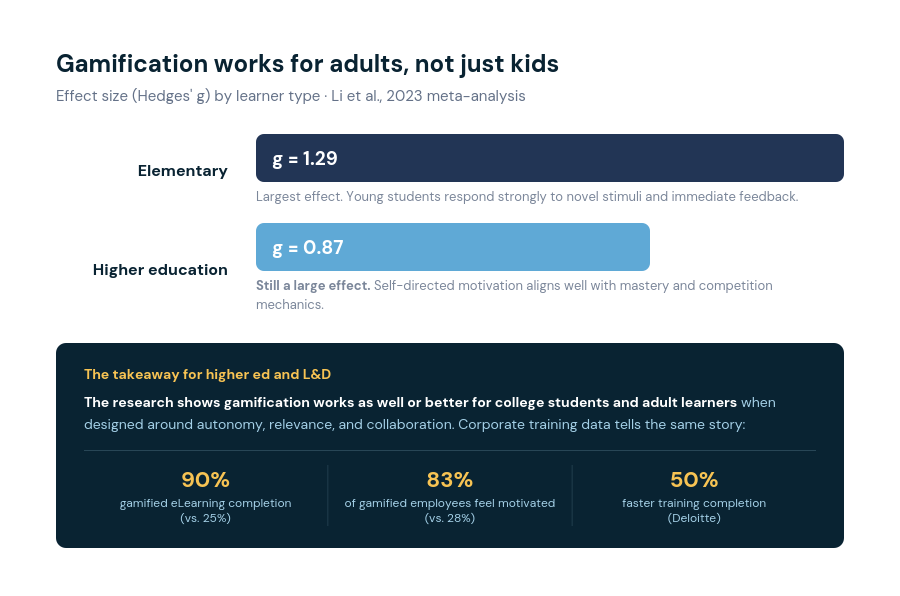 But adult gamification requires specific design thinking grounded in andragogy, not pedagogy. Adults are self-directed. They want relevance. They resist mechanics that feel patronizing. A 2025 qualitative case study in a Dubai corporate training context found that gamification enhanced motivation through achievement and collaboration, but also identified gamification fatigue as a real risk when mechanics become repetitive [19]. The novelty wears off. Effective adult gamification varies its mechanics session to session, introduces new challenge types over time, and gives learners genuine autonomy in how they engage with the competitive elements. If it feels mandatory, it stops working.
Common gamification mistakes (and how to avoid them)
Gartner predicted in 2012 that 80% of gamified applications would fail to meet business objectives due to poor design [21]. That prediction has largely held. If you want gamification to work in your classroom or training program, understanding the failure modes matters as much as knowing what success looks like.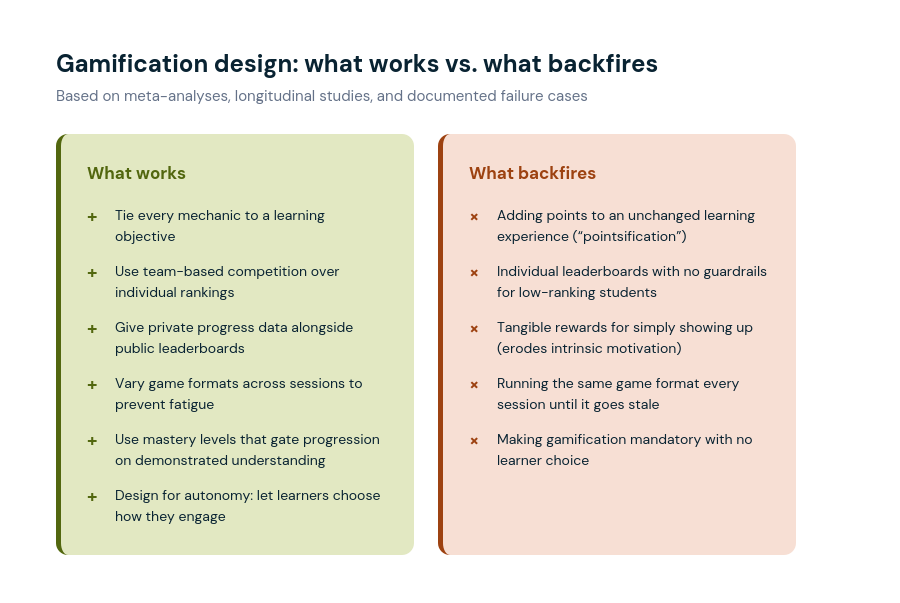
Mistake 1: Pointsification
Margaret Robertson coined this term in 2010 to describe the practice of taking the least essential element of games (points) and treating it as the whole experience [22]. Ian Bogost extended the critique, arguing that much of what gets called gamification is decoration, not design [23]. You’ve probably seen this yourself: a training module gets a leaderboard slapped on it, nothing else changes, and someone calls the program “gamified.” It isn’t. If you add a leaderboard to an unchanged learning experience, you haven’t gamified anything: you’ve decorated it.
Mistake 2: Leaderboards without guardrails
Leaderboards are the game element most frequently associated with negative outcomes in the research [24]. A 2025 study found that negative leaderboard feedback can be more harmful than no feedback at all [25]. The mechanism is intuitive once you think about it: leaderboards motivate the people near the top and demotivate the people near the bottom. Research confirms this is moderated by individual competitiveness. Students who are naturally competitive thrive. Students who aren’t disengage entirely [26].
The fix is design, not avoidance. Use team-based rankings instead of individual ones. Show relative position without exact scores. Reset standings frequently so nobody stays stuck at the bottom. Or limit visibility to the top performers while giving everyone private progress data. Engageli Learning Arcade handles this by combining leaderboard visibility with personal best tracking, so the student who went from 60% to 85% sees that growth even if they’re not first on the board.
Mistake 3: Crowding out intrinsic motivation
This is the big one. Deci, Koestner, and Ryan’s landmark 1999 meta-analysis of 128 experiments showed that tangible, expected rewards undermine intrinsic motivation (d = −0.40 for engagement-contingent rewards) [27]. Hanus and Fox tested this directly in a classroom: over 16 weeks, students in the gamified course showed less motivation, less satisfaction, and lower exam scores than the non-gamified group [28].
The mechanism is called the overjustification effect. When external rewards become the only reason for participating, removing those rewards removes the reason. The practical takeaway: gamification should support learning goals, not replace them. Verbal feedback and competence-affirming mechanics like mastery levels enhance intrinsic motivation. Tangible rewards for just showing up erode it. If your students are only engaging because of the points, you have a problem that will surface the moment the points disappear.
Mistake 4: Running the same game until it’s stale
Gamification often produces strong initial results that fade over weeks. Hamari, Koivisto, and Sarsa’s systematic review of 24 empirical studies found that while most reported positive results, the effects were heavily context-dependent and many showed diminishing returns over time [29]. If you run the same Sprint format or the same quiz game every Tuesday for 14 weeks, it stops being a game and starts being a routine. Effective long-term gamification varies its mechanics. Mix Sprints with Trivia Blast. Alternate team competitions with individual challenges. Introduce new formats before the old ones go flat.
Frequently asked questions
What is gamification in education?
Gamification in education applies game design elements like points, badges, leaderboards, and competitive challenges to learning activities. The goal is to increase student motivation, deepen engagement, and improve learning outcomes by leveraging the psychological principles that make games compelling.
How is gamification different from game-based learning?
Gamification adds game mechanics to existing learning content. A timed quiz competition during a lecture is gamification. Game-based learning places the educational content inside a game. A history simulation is game-based learning. Both improve outcomes, but they serve different instructional purposes and require different design decisions.
Does gamification work for adult learners?
Yes. A 2023 meta-analysis found a large effect size (g = 0.869) for gamification in higher education settings [4]. Adult learners respond best to collaborative and social gamification mechanics rather than purely competitive individual formats. Design for autonomy, relevance, and varied mechanics to avoid fatigue.
What are the best examples of gamification in the classroom?
Duolingo uses streaks and leagues to build daily habits. Khan Academy uses mastery-based progression. Kahoot runs live quiz competitions. Engageli’s Learning Arcade builds AI-generated async quiz games from your own materials, and Sprints add timed competitions to live classroom sessions. Each represents a different approach to the same core idea.
What gamification elements work best for learning?
Meta-analyses show the strongest effects for mechanics tied to competence and progress: mastery levels, skill trees, challenge-based competition. Points and badges work when connected to meaningful milestones. Leaderboards motivate or demotivate depending on design. Team-based competition consistently outperforms individual ranking systems in classroom research.
How do I gamify an online course without losing academic rigor?
Tie every game mechanic to a specific learning objective. Use quiz competitions as retrieval practice. Set difficulty that pushes students to the edge of their competence. Use team formats that require discussion before answering. Replace participation grades with mastery-based progression that rewards demonstrated understanding, not just completion.
What are the risks of gamification in education?
Poorly designed gamification can undermine intrinsic motivation, demoralize students near the bottom of leaderboards, and produce strong initial engagement that fades as the novelty wears off. The research on extrinsic rewards is clear: tangible, expected rewards reduce intrinsic motivation [27]. The solution is thoughtful design, not avoiding gamification entirely.
Can gamification improve student retention in higher education?
The evidence points to yes. Higher education gamification produces a large effect (g = 0.869) on learning outcomes [4], and active learning environments like Engageli’s show 62.7% participation rates versus 5% in traditional lectures [10].
About the author
Lindsey Seril is the Content Marketing Manager at Engageli. She started her career in the classroom, teaching extensively at both the elementary level (Montessori) and in higher education. She holds master’s degrees in education and social psychology. After moving into edtech, Lindsey developed educational content and research for Study.com before joining Engageli, where she writes about active learning, virtual classroom pedagogy, and gamification. Her work is grounded in what she saw firsthand as a teacher: the strategies that actually change how students show up, participate, and retain what they learn.
References
[1] Ryan, R. M., & Deci, E. L. (2000). Self-determination theory and the facilitation of intrinsic motivation, social development, and well-being. American Psychologist, 55(1), 68–78.
[2] Schwartz, M. (n.d.). Gamification in higher education. Centre for Excellence in Learning and Teaching, Toronto Metropolitan University (formerly Ryerson University).
[3] Sailer, M., & Homner, L. (2020). The gamification of learning: A meta-analysis. Educational Psychology Review, 32, 77–112.
[4] Li, X., Xia, Q., Chu, S. K. W., & Yang, Y. (2023). Examining the effectiveness of gamification as a tool promoting teaching and learning in educational settings: A meta-analysis. Frontiers in Psychology, 14, 1253549.
[5] Zeng, J., Parks, S., & Shang, J. (2024). Exploring the impact of gamification on students’ academic performance: A comprehensive meta-analysis of studies from 2008 to 2023. British Journal of Educational Technology, 55(5), 1871–1893.
[6] Kurnaz, F., & Koçtürk, N. (2025). A meta-analysis of gamification’s impact on student motivation in K–12 education. Psychology in the Schools, 62, 4997–5009.
[7] Meister, J. C. (2013, January 2). How Deloitte made learning a game. Harvard Business Review.
[8] Bodnar, Z. (2014). Using game mechanics to enhance leadership education. ACM eLearn Magazine.
[9] TalentLMS. (2019). The 2019 Gamification at Work Survey.
[10] Engageli Active Learning Impact Study, 2024; Engageli Learning Arcade internal data, 2026.
[11] Khan Academy. (n.d.). How do Khan Academy’s Mastery levels work? Khan Academy Help Center.
[12] Gee, J. P. (2003). What video games have to teach us about learning and literacy. Palgrave Macmillan.
[13] Duolingo, Inc. (2025). Q3 2025 Shareholder Letter; Q1 2025 Earnings Release.
[14] Kahoot. (2025). Company overview.
[15] Özdemir, O. (2025). Kahoot! Game-based digital learning platform: A comprehensive meta-analysis. Journal of Computer Assisted Learning.
[16] Koivisto, J., & Hamari, J. (2014). Demographic differences in perceived benefits from gamification. Computers in Human Behavior, 35, 179–188.
[17] Landers, R. N., & Armstrong, M. B. (2019). Gamification of adult learning. In The Cambridge Handbook of Technology and Employee Behavior. Cambridge University Press.
[18] Digital Promise. (2025, July 24). Untapped Potential: Boosting Adult Learning with Artificial Intelligence and Gamification.
[19] Al-Hajri, R., et al. (2025). Exploring the effectiveness of gamification in adult education: A learner-centric qualitative case study in a Dubai training context. Social Sciences & Humanities Open.
[20] HMH. (2023). HMH acquires Canadian edtech company Classcraft. Classcraft original platform shut down June 30, 2024.
[21] Burke, B. (2012, November). Gartner prediction: 80% of gamified applications will fail to meet business objectives by 2014. Gartner Research.
[22] Robertson, M. (2010). Can’t play, won’t play. Hide&Seek (reprinted at Kotaku).
[23] Bogost, I. (2015). Why gamification is bullshit. In S. P. Walz & S. Deterding (Eds.), The Gameful World (pp. 65–79). MIT Press.
[24] Toda, A. M., Valle, P. H. D., & Isotani, S. (2018). The dark side of gamification: An overview of negative effects of gamification in education. In Higher Education for All. Springer.
[25] Nebel, S., Ninaus, M., & Schneider, S. (2025). The winner takes it all: Effects of leaderboard-based feedback on cognitive performance and motivation. Learning and Individual Differences.
[26] Na, Y., & Han, S. (2024). Personalization in educational gamification: Learners with different trait competitiveness benefit differently from rankings on leaderboards. Computers & Education, 217, 105082.
[27] Deci, E. L., Koestner, R., & Ryan, R. M. (1999). A meta-analytic review of experiments examining the effects of extrinsic rewards on intrinsic motivation. Psychological Bulletin, 125(6), 627–668.
[28] Hanus, M. D., & Fox, J. (2015). Assessing the effects of gamification in the classroom: A longitudinal study. Computers & Education, 80, 152–161.
[29] Hamari, J., Koivisto, J., & Sarsa, H. (2014). Does gamification work? A literature review of empirical studies on gamification. Proceedings of the 47th HICSS, 3025–3034. IEEE