

Many years ago, when I was teaching second grade, our classroom was organized around rotating tables, each designed for a different activity. After completing the first and second assignment, the final stop was always the iPad table where students could research their science projects together and explore videos, a real treat for second graders during class time.
What stood out wasn’t the technology. It was the energy. The moment students reached that table, the room came alive. They leaned in, exchanged ideas, debated topics, and built on each other’s thinking. That’s when I realized the true power of peer-to-peer learning online and in person: it’s about connection and collaboration, not access to content alone.
Why Peer-to-Peer Learning Matters More in the Online Classroom
What’s exciting today is that the brilliant architecture of the Engageli classroom brings that same peer-to-peer learning dynamic into the online classroom, intentionally designing collaborative, safe spaces where students don’t just learn individually, but actively learn from each other.
Teaching across both in-person and online environments has highlighted the challenge of delivering a cohesive learning experience. The pandemic was a turning point since it showed us that effective education now requires a more thoughtful and creative use of technology as students increasingly move toward flexible, online formats.
Collaborative Learning Online: 3 Peer Instruction Strategies Educators Use in Engageli
Here are some of the peer-to-peer learning strategies educators commonly use in the Engageli classroom.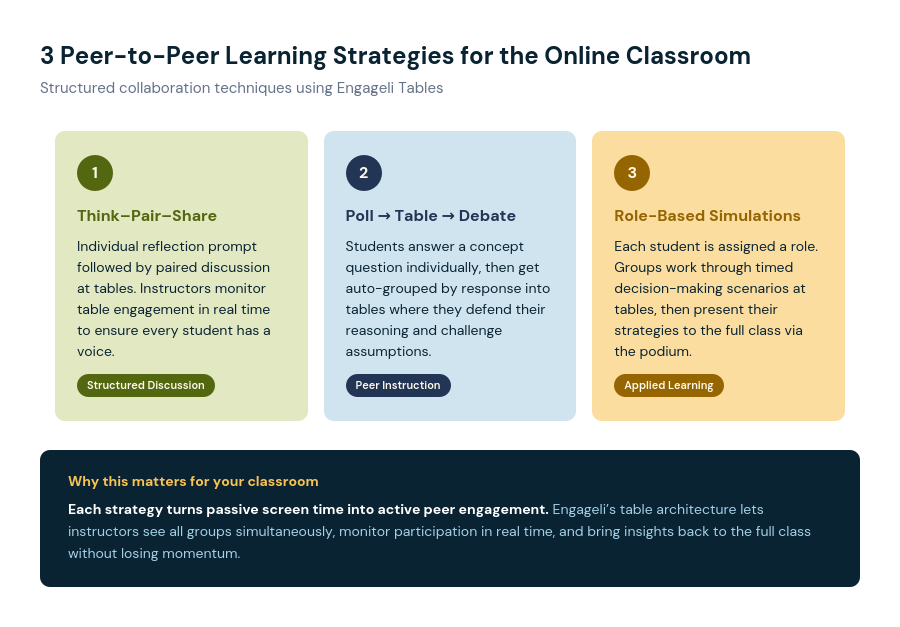
1. Think–Pair–Share
A classic pedagogy strategy that is optimized in Engageli using the classroom tables is where there is an individual reflection prompt and each pair can discuss at their tables. This ensures that everyone has a voice and instructors can monitor table engagement to ensure everyone is participating at the tables.
The classroom analytics show higher participation vs. traditional instruction on a video conferencing system where only a few are provided opportunities to speak.
2. Poll → Table Seating → Debate
Students answer a concept question individually. Instructors then automatically group students by similar or diverse answers using a poll split feature. The classroom moves into table discussion where students defend their reasoning in small tables and the groups challenge assumptions and refine answers. After the group exercise, the instructor brings insights back to the full class by asking a group leader from each table to raise their hand to the podium to share the table discussion insights.
Instructors can quickly turn a simple poll into critical thinking and peer instruction at scale instead of just checking comprehension.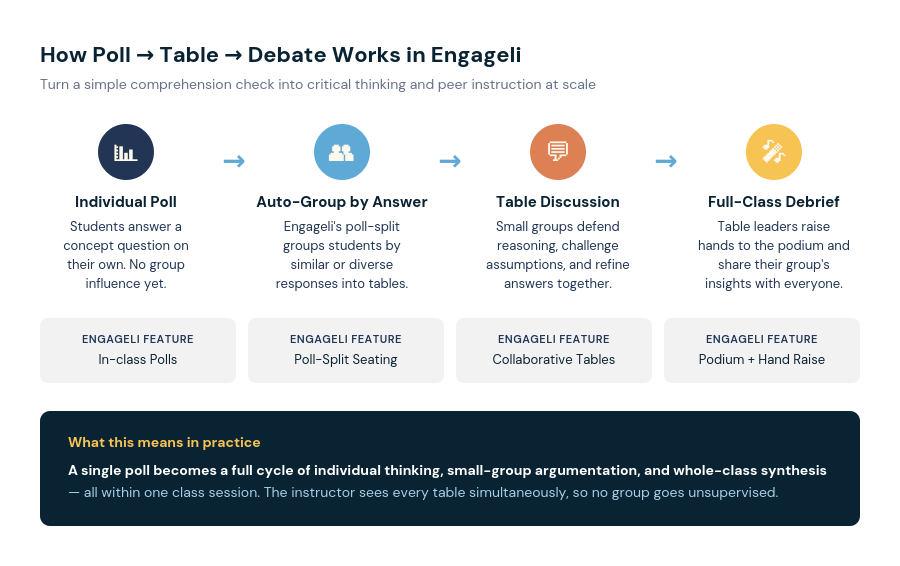
3. Role-Based Simulations for Real-World Decision Making
Each student at a table is assigned a role based on the prompt, and groups work together to make decisions in a timed activity using the classroom timer to pace the class. Within their tables, students simulate real-world decision-making to discuss options, weigh trade-offs, and arrive at a shared solution.
Each group then presents their strategy to the full class using the podium, while peers analyze and discuss the different approaches. The instructor can compare decision-making patterns across groups and guide reflection on outcomes and reasoning.
This approach fosters perspective-taking, negotiation, and real-world thinking. It builds applied learning and teamwork: critical skills that employers consistently value.
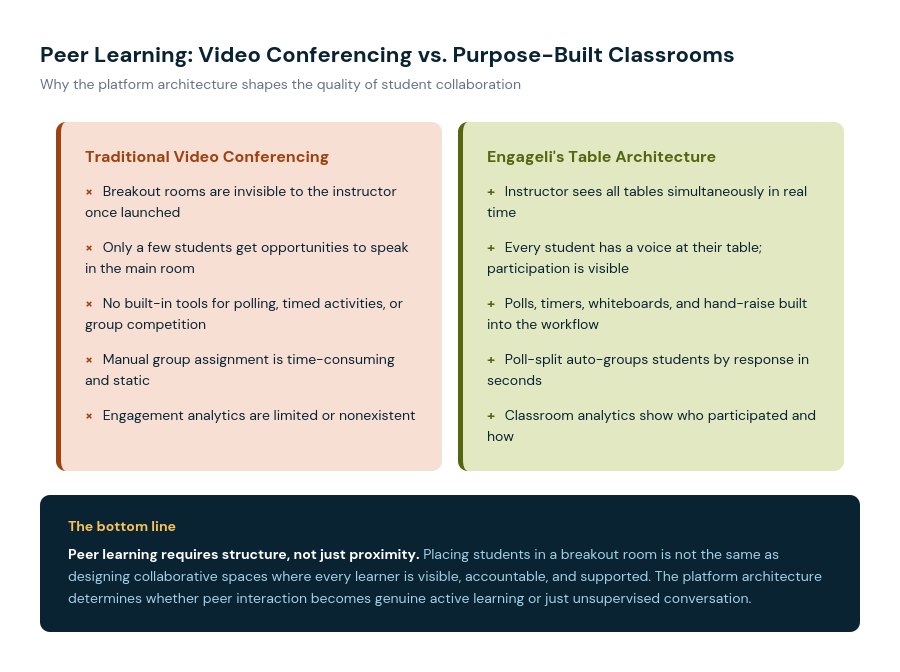
Why Classroom Architecture Shapes Peer Learning Outcomes
 I still find myself coming back to that second-grade classroom because that’s where I saw firsthand how transformative peer-to-peer learning can be and how it improved student learning.
Today, in a world overflowing with content, interaction is what sets learning apart. The institutions that are student-centric will be those that move beyond delivery and create environments built for collaboration. This is especially important in the online classroom, where students need opportunities to organically engage, collaborate, and build meaningful relationships with their peers. Engageli makes this possible by turning the virtual classroom into a structured, interactive environment where peer connection happens naturally.
See how Engageli’s Tables make peer-to-peer learning work at scale. Request a demonstration with our team of educators.
Frequently Asked Questions
What is peer-to-peer learning in online education?
Peer-to-peer learning online is a collaborative approach where students learn from and with each other through structured activities like group discussions, debates, and simulations. In purpose-built virtual classrooms like Engageli, tables provide the small-group structure that makes this interaction productive rather than chaotic.
How is Engageli different from Zoom breakout rooms for group work?
Engageli Tables are visible to the instructor simultaneously, so no group goes unsupervised. Instructors can monitor engagement, auto-group students by poll response, and bring table leaders to the podium. Zoom breakout rooms are invisible once launched and lack built-in collaboration tools.
What is the poll-split feature in Engageli?
Poll-split automatically groups students into Engageli Tables based on their individual poll responses. Instructors can seat students with similar answers together for consensus building, or with diverse answers to spark productive debate and peer instruction.
Does Think-Pair-Share work effectively in virtual classrooms?
Yes. When structured with dedicated small-group spaces like Engageli Tables, Think-Pair-Share works well online. The key is that instructors can monitor every pair in real time and classroom analytics confirm higher participation rates compared to traditional whole-class video conferencing instruction.
How do role-based simulations improve online learning?
Role-based simulations require students to adopt different perspectives, negotiate with peers, and make collaborative decisions under time constraints. These activities build applied learning and teamwork skills. In Engageli, the classroom timer paces the activity while groups work at their tables before presenting to the full class.
What are the best active learning strategies for online classes?
Effective online active learning strategies include poll-driven peer instruction, structured Think-Pair-Share, role-based simulations, Socratic seminars, and jigsaw activities. The common thread is that all of these require small-group collaboration spaces and instructor visibility into group dynamics.
Can peer learning strategies scale to large online classes?
Peer learning scales when the platform supports it architecturally. Engageli’s table structure lets instructors run collaborative activities with hundreds of students simultaneously. Every student is seated at a table, every table is visible, and features like poll-split and hand-raise-to-podium make whole-class synthesis efficient at any class size.