

Anita leads demos, onboarding, and customer training across Engageli's K-12, higher education, and corporate learning customers.
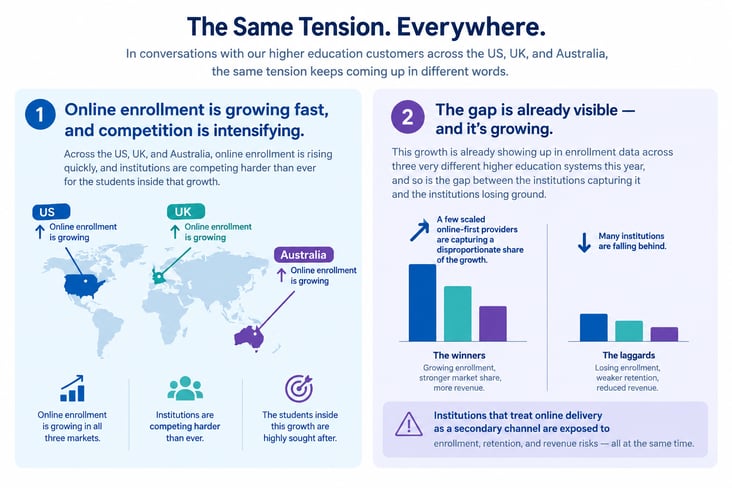
In conversations with our higher education customers across the US, UK, and Australia, the same tension keeps coming up in different words. Online enrollment is growing quickly in every one of these markets, and institutions are competing harder than ever for the students inside that growth.
Higher education needs a deliberate online strategy because online enrollment is growing sharply across multiple countries at once, a small number of scaled online-first providers are already capturing a disproportionate share of that growth, and students already expect the online experience to work as well as the physical classroom. Institutions that treat online delivery as a secondary channel are exposed to enrollment, retention, and revenue factors at the same time.
That growth is already visible in enrollment data across three very different higher education systems this year, and so is the gap between the institutions capturing it and the institutions losing ground.
How Fast is Online Enrollment Actually Growing in Higher Education?
In the United States, online enrollment keeps climbing. NCES data show 54.7% of postsecondary students took at least one online course in fall 2024, up from 54.2% the year before, with distance education participation growing by roughly 441,000 students in a single year.¹ Students studying exclusively online now make up 26.5% of total enrollment.
In the UK, the growth is concentrated at the postgraduate level. Online postgraduate enrollment reached nearly 95,000 students in 2024/25, up from about 56,000 in 2018/19, and the number of providers with more than 1,000 online postgraduate students has more than tripled, from 10 to 32, over the same period.² A much larger field of institutions is now competing for that same growing pool.
In Australia, external and multimodal delivery combined now account for 44% of higher education enrollments, and overall enrollment grew 4.7% in the most recent year on record.³ Online and blended study has become how a large share of Australian students actually learn.
| Region | What the growth looks like | The data point |
| United States | Broad-based growth across online formats | 54.7% of students took at least one online course in fall 2024, up 441,000 students year over year¹ |
| United Kingdom | Concentrated growth at the postgraduate level | Online postgraduate enrollment near 95,000, up from 56,000 in 2018/19; scaled providers grew from 10 to 32² |
| Australia | Online and blended delivery now mainstream | 44% of higher education enrollments are external or multimodal³ |
Three different patterns, one shared reality: in every one of these systems, online delivery now represents a substantial and growing share of how higher education is actually delivered..
Why Are Institutions Losing Students to Online-First Competitors, Even When Their Own Enrollment Holds Steady?
That growth concentrates fast. Fully online enrollment in the US grew 10% between fall 2022 and fall 2024, over 400,000 more students, and Western Governors University (WGU) alone grew 33% in that window.⁴ WGU now captures 12% of total enrollment in Texas, and in South Carolina, half of all online enrollment comes from out-of-state institutions.
That pattern holds regardless of an institution's own demographic outlook. Students are choosing based on the quality of the online experience, and a handful of scaled providers are winning that comparison. Every student they enroll is a student of a regional institution they will not get back.
Is the Real Exposure at the Top of the Funnel, or After a Student Already Enrolls?
Most institutions still put their strategic energy into recruitment marketing, chasing a growing pool of prospective online students. EAB research found the share of prospective students using AI tools to research programs jumped roughly fivefold in a year, from about 4% to nearly one in five.⁵
Recruitment spend, however, cannot fix what happens after a student enrolls. Deans of Virtual Learning describe the same frustration: breakout rooms scatter students into groups the instructor cannot see, so many default to whole-class lecture format, which quietly erodes the collaborative learning that keeps students particularly engaged in the online modality.
The Reasons Higher Education Needs to Focus on Active Learning for Online Delivery
Online delivery matters to a modern campus for reasons beyond competitive pressure. It makes a program accessible to learners who cannot be in a physical classroom, and it gives an institution a real financial lever: building programs and enrolling more students without adding physical infrastructure. None of that changes what happens once a student logs in, and that is where active learning becomes the deciding factor.
- Passive viewing is easy to mistake for engagement: Watching a lecture or reading slides can look like participation, but it asks little of a student beyond attention. Active learning asks students to apply an idea, discuss it, solve it, explain their reasoning, or create something from it, a different cognitive task entirely. Higher ed institutions are increasingly adult learners who need flexibility with engaging asynchronous learning.
- Engagement is genuinely harder to read online: In a physical classroom, an instructor can see confusion, energy, or a student pulling back. Those signals weaken online. A deliberate active-learning strategy gives students structured reasons to participate, and rich engagement analytics let an instructor spot who needs help before the signal disappears.
- Flexibility and isolation arrive together: Online study offers real convenience, but a student watching a recorded lecture alone can feel disconnected from instructor and peers. Discussion, collaboration, peer feedback, case studies, simulations, and group problem-solving restore the social dimension a passive format leaves out.
- What students learn has to hold up outside the course: Employers want graduates who can analyze a problem, make a decision, communicate it, collaborate with a team, and adapt when the situation changes. Active learning builds exactly those capabilities, because it asks students to practice the decision, the analysis, and the collaboration itself.
- Technology has caught up with ambition. Collaborative tools, simulations, polling, and game-based learning now make it possible to build genuinely active experiences into an online course without requiring all of it to happen synchronously.
When a course is designed this way, engagement and perceived value both rise, and that has a direct line to retention, satisfaction, and how a student ultimately judges the institution that taught them.
What Does an Online Experience That Actually Retains Students Look Like?
Across Engageli's higher education customers in the US, UK, and Australia, verified case study data shows an 18% increase in course completion after moving from passive video-conferencing tools to a platform built for active learning.⁶
At one US university partner, the shift produced a 7% higher pass rate, twice as many A grades, and a 1.5% increase in persistence.⁷ At a UK partner, sessions built around persistent small-group tables, visible to the instructor throughout, achieved 100% participation in sessions required to meet the UK's regulated study intensity standard.⁸
The common thread is visibility. When instructors can see and support every small group in real time, they can intervene before a disengaged student withdraws. The individual engagement data to power the student service engine becomes a critical component of the classroom strategy.
Why This Has Become a Financial Question, Not Just an Academic One
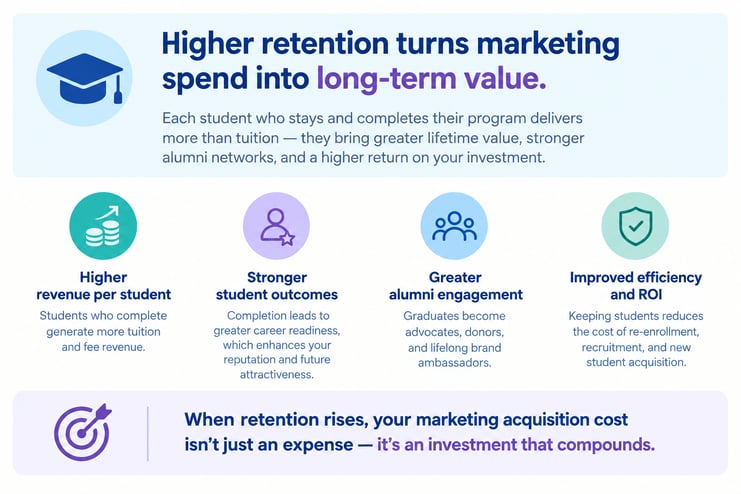
Put the growth and the competition together and the stakes are clear. Online enrollment is expanding across the US, UK, and Australia, but a handful of scaled providers are capturing an outsized share of it, and students who do enroll are choosing based on experience. Every student who disengages and leaves is a student, a competitor built for online delivery is ready to absorb, and that is a concrete line item on next year's budget. Lifelong learners who return to their original college or university often do so because they trust the community and value the quality of instruction they received before, increasing the ROI on the marketing acquisition investment.
Closing Thought
I keep coming back to that same tension I hear from our higher education customers: how to keep the students already enrolled, when competition for new ones is fiercer than it has been in a decade. That question starts with treating the online classroom as seriously as the one down the hall. If your team wants to talk through what that looks like for your institution, we would welcome the conversation.
Key Takeaways
• Online enrollment is growing across the US, UK, and Australia: broad-based growth in the US, a postgraduate boom in the UK, and online and blended study becoming mainstream in Australia.
• Scaled online-first providers like WGU are capturing a disproportionate share of that growth inside institutions' own regions.
• Passive viewing, weak engagement signals, and isolation are the default failure modes of online delivery, and active learning design is what corrects them.
• Recruitment marketing cannot offset losses that happen after enrollment, when a weak online experience causes disengagement and withdrawal.
• Verified case study data across Engageli's higher education customers shows an 18% increase in course completion tied to active-learning online delivery.
References
1. NCES, Digest of Education Statistics, Table 311.15, comparing fall 2023 and fall 2024 distance education enrollment (2026).
2. HESA data, analysis via Neil Mosley Consulting, "UK HE Online Student Trends 2024/25" (2026).
3. Australian Government higher education statistics and NCVER data, via DigitalDefynd analysis (2025).
4. Encoura, "Your Backyard, Their Students" (2026).
5. EAB, "4 Predictions for 2026" (2026).
6. Engageli internal research: higher education case studies, US/UK/Australia.
7. Engageli internal research: US university partner case study.
8. Engageli internal research: UK university partner case study.